
UNITED STATES
SECURITIES AND EXCHANGE COMMISSION
Washington, D.C. 20549
Form 10-Q
QUARTERLY REPORT PURSUANT TO SECTION 13 OR 15(d)
OF THE SECURITIES EXCHANGE ACT OF 1934
For the Quarterly Period Ended | Commission File Number | |||
October 29, 2017 | 1-3822 | |||

CAMPBELL SOUP COMPANY
New Jersey | 21-0419870 |
State of Incorporation | I.R.S. Employer Identification No. |
1 Campbell Place
Camden, New Jersey 08103-1799
Principal Executive Offices
Telephone Number: (856) 342-4800
Indicate by check mark whether the registrant: (1) has filed all reports required to be filed by Section 13 or 15(d) of the Securities Exchange Act of 1934 during the preceding 12 months (or for such shorter period that the registrant was required to file such reports), and (2) has been subject to such filing requirements for the past 90 days. þ Yes ☐ No
Indicate by check mark whether the registrant has submitted electronically and posted on its corporate web site, if any, every Interactive Data File required to be submitted and posted pursuant to Rule 405 of Regulation S-T during the preceding 12 months (or for such shorter period that the registrant was required to submit and post such files). þ Yes ☐ No
Indicate by check mark whether the registrant is a large accelerated filer, an accelerated filer, a non-accelerated filer, a smaller reporting company or an emerging growth company. See the definitions of "large accelerated filer," "accelerated filer," "smaller reporting company," and "emerging growth company" in Rule 12b-2 of the Exchange Act.
Large accelerated filer þ | Accelerated filer ☐ |
Non-accelerated filer ☐ (Do not check if a smaller reporting company) | Smaller reporting company ☐ |
Emerging growth company ☐ | |
If an emerging growth company, indicate by check mark if the registrant has elected not to use the extended transition period for complying with any new or revised financial accounting standards provided pursuant to Section 13(a) of the Exchange Act. ☐
Indicate by check mark whether the registrant is a shell company (as defined in Rule 12b-2 of the Exchange Act). ☐ Yes þ No
There were 300,606,995 shares of capital stock outstanding as of November 30, 2017.
TABLE OF CONTENTS
2
PART I - FINANCIAL INFORMATION
Item 1. Financial Statements
CAMPBELL SOUP COMPANY
Consolidated Statements of Earnings
(unaudited)
(millions, except per share amounts)
Three Months Ended | ||||||||
October 29, 2017 | October 30, 2016 | |||||||
Net sales | $ | 2,161 | $ | 2,202 | ||||
Costs and expenses | ||||||||
Cost of products sold | 1,378 | 1,351 | ||||||
Marketing and selling expenses | 219 | 230 | ||||||
Administrative expenses | 149 | 125 | ||||||
Research and development expenses | 30 | 27 | ||||||
Other expenses / (income) | (29 | ) | 11 | |||||
Restructuring charges | 2 | 1 | ||||||
Total costs and expenses | 1,749 | 1,745 | ||||||
Earnings before interest and taxes | 412 | 457 | ||||||
Interest expense | 31 | 29 | ||||||
Interest income | 1 | 1 | ||||||
Earnings before taxes | 382 | 429 | ||||||
Taxes on earnings | 107 | 137 | ||||||
Net earnings | 275 | 292 | ||||||
Less: Net earnings (loss) attributable to noncontrolling interests | — | — | ||||||
Net earnings attributable to Campbell Soup Company | $ | 275 | $ | 292 | ||||
Per Share — Basic | ||||||||
Net earnings attributable to Campbell Soup Company | $ | .91 | $ | .95 | ||||
Dividends | $ | .35 | $ | .35 | ||||
Weighted average shares outstanding — basic | 301 | 308 | ||||||
Per Share — Assuming Dilution | ||||||||
Net earnings attributable to Campbell Soup Company | $ | .91 | $ | .94 | ||||
Weighted average shares outstanding — assuming dilution | 302 | 310 | ||||||
See accompanying Notes to Consolidated Financial Statements.
3
CAMPBELL SOUP COMPANY
Consolidated Statements of Comprehensive Income
(unaudited)
(millions)
Three Months Ended | |||||||||||||||||||||||
October 29, 2017 | October 30, 2016 | ||||||||||||||||||||||
Pre-tax amount | Tax (expense) benefit | After-tax amount | Pre-tax amount | Tax (expense) benefit | After-tax amount | ||||||||||||||||||
Net earnings | $ | 275 | $ | 292 | |||||||||||||||||||
Other comprehensive income (loss): | |||||||||||||||||||||||
Foreign currency translation: | |||||||||||||||||||||||
Foreign currency translation adjustments | $ | (32 | ) | $ | — | (32 | ) | $ | (8 | ) | $ | — | (8 | ) | |||||||||
Cash-flow hedges: | |||||||||||||||||||||||
Unrealized gains (losses) arising during period | 9 | (2 | ) | 7 | 13 | (5 | ) | 8 | |||||||||||||||
Reclassification adjustment for (gains) losses included in net earnings | (2 | ) | — | (2 | ) | 2 | — | 2 | |||||||||||||||
Pension and other postretirement benefits: | |||||||||||||||||||||||
Reclassification of prior service credit included in net earnings | (7 | ) | 2 | (5 | ) | (6 | ) | 2 | (4 | ) | |||||||||||||
Other comprehensive income (loss) | $ | (32 | ) | $ | — | (32 | ) | $ | 1 | $ | (3 | ) | (2 | ) | |||||||||
Total comprehensive income (loss) | $ | 243 | $ | 290 | |||||||||||||||||||
Total comprehensive income (loss) attributable to noncontrolling interests | — | 1 | |||||||||||||||||||||
Total comprehensive income (loss) attributable to Campbell Soup Company | $ | 243 | $ | 289 | |||||||||||||||||||
See accompanying Notes to Consolidated Financial Statements.
4
CAMPBELL SOUP COMPANY
Consolidated Balance Sheets
(unaudited)
(millions, except per share amounts)
October 29, 2017 | July 30, 2017 | ||||||
Current assets | |||||||
Cash and cash equivalents | $ | 163 | $ | 319 | |||
Accounts receivable, net | 766 | 605 | |||||
Inventories | 1,001 | 902 | |||||
Other current assets | 66 | 74 | |||||
Total current assets | 1,996 | 1,900 | |||||
Plant assets, net of depreciation | 2,417 | 2,454 | |||||
Goodwill | 2,086 | 2,115 | |||||
Other intangible assets, net of amortization | 1,112 | 1,118 | |||||
Other assets ($56 as of 2018 and $51 as of 2017 attributable to variable interest entity) | 135 | 139 | |||||
Total assets | $ | 7,746 | $ | 7,726 | |||
Current liabilities | |||||||
Short-term borrowings | $ | 1,192 | $ | 1,037 | |||
Payable to suppliers and others | 713 | 666 | |||||
Accrued liabilities | 518 | 561 | |||||
Dividends payable | 107 | 111 | |||||
Accrued income taxes | 53 | 20 | |||||
Total current liabilities | 2,583 | 2,395 | |||||
Long-term debt | 2,269 | 2,499 | |||||
Deferred taxes | 531 | 490 | |||||
Other liabilities | 674 | 697 | |||||
Total liabilities | 6,057 | 6,081 | |||||
Commitments and contingencies | |||||||
Campbell Soup Company shareholders' equity | |||||||
Preferred stock; authorized 40 shares; none issued | — | — | |||||
Capital stock, $.0375 par value; authorized 560 shares; issued 323 shares | 12 | 12 | |||||
Additional paid-in capital | 305 | 359 | |||||
Earnings retained in the business | 2,555 | 2,385 | |||||
Capital stock in treasury, at cost | (1,106 | ) | (1,066 | ) | |||
Accumulated other comprehensive loss | (85 | ) | (53 | ) | |||
Total Campbell Soup Company shareholders' equity | 1,681 | 1,637 | |||||
Noncontrolling interests | 8 | 8 | |||||
Total equity | 1,689 | 1,645 | |||||
Total liabilities and equity | $ | 7,746 | $ | 7,726 | |||
See accompanying Notes to Consolidated Financial Statements.
5
CAMPBELL SOUP COMPANY
Consolidated Statements of Cash Flows
(unaudited)
(millions)
Three Months Ended | |||||||
October 29, 2017 | October 30, 2016 | ||||||
Cash flows from operating activities: | |||||||
Net earnings | $ | 275 | $ | 292 | |||
Adjustments to reconcile net earnings to operating cash flow | |||||||
Restructuring charges | 2 | 1 | |||||
Stock-based compensation | 14 | 14 | |||||
Pension and postretirement benefit income | (16 | ) | (11 | ) | |||
Depreciation and amortization | 82 | 77 | |||||
Deferred income taxes | 41 | 19 | |||||
Other, net | 6 | (2 | ) | ||||
Changes in working capital | |||||||
Accounts receivable | (167 | ) | (218 | ) | |||
Inventories | (105 | ) | (27 | ) | |||
Prepaid assets | 16 | (6 | ) | ||||
Accounts payable and accrued liabilities | 84 | 96 | |||||
Net payments of hedging activities | (33 | ) | (2 | ) | |||
Other | (11 | ) | (12 | ) | |||
Net cash provided by operating activities | 188 | 221 | |||||
Cash flows from investing activities: | |||||||
Purchases of plant assets | (58 | ) | (48 | ) | |||
Other, net | (5 | ) | (4 | ) | |||
Net cash used in investing activities | (63 | ) | (52 | ) | |||
Cash flows from financing activities: | |||||||
Net short-term borrowings (repayments) | (60 | ) | 86 | ||||
Long-term repayments | — | (27 | ) | ||||
Dividends paid | (111 | ) | (100 | ) | |||
Treasury stock purchases | (86 | ) | (112 | ) | |||
Payments related to tax withholding for stock-based compensation | (22 | ) | (20 | ) | |||
Net cash used in financing activities | (279 | ) | (173 | ) | |||
Effect of exchange rate changes on cash | (2 | ) | (2 | ) | |||
Net change in cash and cash equivalents | (156 | ) | (6 | ) | |||
Cash and cash equivalents — beginning of period | 319 | 296 | |||||
Cash and cash equivalents — end of period | $ | 163 | $ | 290 | |||
See accompanying Notes to Consolidated Financial Statements.
6
CAMPBELL SOUP COMPANY
Consolidated Statements of Equity
(unaudited)
(millions, except per share amounts)
Campbell Soup Company Shareholders’ Equity | |||||||||||||||||||||||||||||||||
Capital Stock | Additional Paid-in Capital | Earnings Retained in the Business | Accumulated Other Comprehensive Income (Loss) | Noncontrolling Interests | |||||||||||||||||||||||||||||
Issued | In Treasury | Total Equity | |||||||||||||||||||||||||||||||
Shares | Amount | Shares | Amount | ||||||||||||||||||||||||||||||
Balance at July 31, 2016 | 323 | $ | 12 | (15 | ) | $ | (664 | ) | $ | 354 | $ | 1,927 | $ | (104 | ) | $ | 8 | $ | 1,533 | ||||||||||||||
Net earnings (loss) | 292 | — | 292 | ||||||||||||||||||||||||||||||
Other comprehensive income (loss) | (3 | ) | 1 | (2 | ) | ||||||||||||||||||||||||||||
Dividends ($.35 per share) | (107 | ) | (107 | ) | |||||||||||||||||||||||||||||
Treasury stock purchased | (2 | ) | (112 | ) | (112 | ) | |||||||||||||||||||||||||||
Treasury stock issued under management incentive and stock option plans | 1 | 31 | (37 | ) | (6 | ) | |||||||||||||||||||||||||||
Balance at October 30, 2016 | 323 | $ | 12 | (16 | ) | $ | (745 | ) | $ | 317 | $ | 2,112 | $ | (107 | ) | $ | 9 | $ | 1,598 | ||||||||||||||
Balance at July 30, 2017 | 323 | $ | 12 | (22 | ) | $ | (1,066 | ) | $ | 359 | $ | 2,385 | $ | (53 | ) | $ | 8 | $ | 1,645 | ||||||||||||||
Net earnings (loss) | 275 | — | 275 | ||||||||||||||||||||||||||||||
Other comprehensive income (loss) | (32 | ) | — | (32 | ) | ||||||||||||||||||||||||||||
Dividends ($.35 per share) | (105 | ) | (105 | ) | |||||||||||||||||||||||||||||
Treasury stock purchased | (2 | ) | (86 | ) | (86 | ) | |||||||||||||||||||||||||||
Treasury stock issued under management incentive and stock option plans | 2 | 46 | (54 | ) | (8 | ) | |||||||||||||||||||||||||||
Balance at October 29, 2017 | 323 | $ | 12 | (22 | ) | $ | (1,106 | ) | $ | 305 | $ | 2,555 | $ | (85 | ) | $ | 8 | $ | 1,689 | ||||||||||||||
See accompanying Notes to Consolidated Financial Statements.
7
Notes to Consolidated Financial Statements
(unaudited)
(currency in millions, except per share amounts)
1. | Basis of Presentation and Significant Accounting Policies |
In this Form 10-Q, unless otherwise stated, the terms "we," "us," "our" and the "company" refer to Campbell Soup Company and its consolidated subsidiaries.
The consolidated financial statements include our accounts and entities in which we maintain a controlling financial interest and a variable interest entity (VIE) for which we are the primary beneficiary. Intercompany transactions are eliminated in consolidation. Certain amounts in prior-year financial statements were reclassified to conform to the current-year presentation.
The financial statements reflect all adjustments which are, in our opinion, necessary for a fair statement of the results of operations, financial position, and cash flows for the indicated periods. The accounting policies we used in preparing these financial statements are substantially consistent with those we applied in our Annual Report on Form 10-K for the year ended July 30, 2017, except as described in Note 2.
The results for the period are not necessarily indicative of the results to be expected for other interim periods or the full year. Our fiscal year ends on the Sunday nearest July 31.
2. | Recent Accounting Pronouncements |
In May 2014, the Financial Accounting Standards Board (FASB) issued revised guidance on the recognition of revenue from contracts with customers. The guidance is designed to create greater comparability for financial statement users across industries and jurisdictions. The guidance also requires enhanced disclosures. The guidance was originally effective for fiscal years, and interim periods within those years, beginning after December 15, 2016. In July 2015, the FASB decided to delay the effective date of the new revenue guidance by one year to fiscal years, and interim periods within those years, beginning after December 15, 2017. Entities will be permitted to adopt the new revenue standard early, but not before the original effective date. The guidance permits the use of either a full retrospective or modified retrospective transition method. We are currently performing a diagnostic review of our arrangements with customers across our significant businesses, including our practices of offering rebates, refunds, discounts and other price allowances, and trade and consumer promotion programs. We are evaluating our methods of estimating the amount and timing of these various forms of variable consideration. We are continuing to evaluate the impact that the new guidance will have on our consolidated financial statements, as well as which transition method we will use. We will adopt the new guidance in 2019.
In January 2016, the FASB issued guidance that amends the recognition and measurement of financial instruments. The changes primarily affect the accounting for equity investments, financial liabilities under the fair value option, and the presentation and disclosure requirements for financial instruments. Under the new guidance, equity investments in unconsolidated entities that are not accounted for under the equity method will generally be measured at fair value through earnings. When the fair value option has been elected for financial liabilities, changes in fair value due to instrument-specific credit risk will be recognized separately in other comprehensive income. The guidance is effective for fiscal years beginning after December 15, 2017, and interim periods within those years. We are currently evaluating the impact that the new guidance will have on our consolidated financial statements.
In February 2016, the FASB issued guidance that amends accounting for leases. Under the new guidance, a lessee will recognize assets and liabilities for most leases but will recognize expenses similar to current lease accounting. The guidance is effective for fiscal years, and interim periods within those years, beginning after December 15, 2018. Early adoption is permitted. The new guidance must be adopted using a modified retrospective transition, and provides for certain practical expedients. We are currently evaluating the impact that the new guidance will have on our consolidated financial statements.
In August 2016, the FASB issued guidance on the classification of certain cash receipts and payments in the statement of cash flows. The guidance is effective for fiscal years beginning after December 15, 2017, and interim periods within those years. Early adoption is permitted. The guidance must be applied retrospectively to all periods presented but may be applied prospectively if retrospective application would be impracticable. We are currently evaluating the impact that the new guidance will have on our consolidated financial statements.
In October 2016, the FASB issued guidance on tax accounting for intra-entity asset transfers. Under current guidance, the tax effects of intra-entity asset transfers (intercompany sales) are deferred until the transferred asset is sold to a third party or otherwise recognized. The new guidance requires companies to account for the income tax effects on intercompany transfers of assets other than inventory when the transfer occurs. The new guidance is effective for fiscal years beginning after December 15, 2017, and interim periods within those years. Early adoption is permitted in the first interim period of a fiscal year. The modified retrospective approach is required upon adoption, with a cumulative-effect adjustment recorded in retained earnings as of the beginning of the period of adoption. We are currently evaluating the impact that the new guidance will have on our consolidated financial statements.
8
In January 2017, the FASB issued guidance that revises the definition of a business to assist entities with evaluating when a set of transferred assets and activities is a business. The guidance requires an entity to evaluate if substantially all of the fair value of the gross assets acquired is concentrated in a single identifiable asset or a group of similar identifiable assets. If this threshold is met, the set of transferred assets and activities is not a business. If it is not met, the entity then evaluates whether the set meets the requirement that a business include, at a minimum, an input and a substantive process that together significantly contribute to the ability to create outputs. The guidance is effective for fiscal years beginning after December 15, 2017, and interim periods within those years. Early adoption is permitted. We will prospectively apply the guidance to applicable transactions.
In March 2017, the FASB issued guidance that changes the presentation of net periodic pension cost and net periodic postretirement benefit cost. Under the revised guidance, the service cost component of benefit cost is classified in the same line item or items as other compensation costs arising from services rendered by the pertinent employees during the period. The other components of net benefit cost (such as interest expense, return on assets, amortization of prior service credit, actuarial gains and losses, settlements and curtailments) are required to be presented in the income statement separately from the service cost component. The guidance also allows only the service cost component to be eligible for capitalization when applicable (for example, as a cost of internally manufactured inventory). The guidance should be applied retrospectively for the presentation of the service cost component and the other components of benefit cost in the income statement, and applied prospectively on and after the effective date for the capitalization of the service cost component. The guidance is effective for fiscal years beginning after December 15, 2017, and interim periods within those years. Early adoption is permitted. We elected to early adopt the guidance in the first quarter of 2018. The retrospective impact of presenting net periodic benefit cost in accordance with the new guidance is as follows:
Three Months Ended | ||||
Increase / (decrease) in expense | October 30, 2016 | |||
Cost of products sold | $ | (10 | ) | |
Marketing and selling expenses | $ | 2 | ||
Administrative expenses | $ | 2 | ||
Research and development expenses | $ | 1 | ||
Other expenses / (income) | $ | 5 | ||
In May 2017, the FASB issued guidance that clarifies when changes to the terms or conditions of a share-based payment award must be accounted for as modifications. Under the new guidance, modification accounting is required only if the value, the vesting conditions, or the classification of the award (as equity or liability) changes as a result of the change in terms or conditions. The guidance is effective prospectively for fiscal years beginning after December 15, 2017. Early adoption is permitted. We will apply the guidance in evaluating future changes to terms or conditions of share-based payment awards.
In August 2017, the FASB issued guidance that amends hedge accounting. Under the new guidance, more hedging strategies will be eligible for hedge accounting and the application of hedge accounting is simplified. The new guidance amends presentation and disclosure requirements, and how effectiveness is assessed. The guidance is effective for fiscal years beginning after December 15, 2018, and interim periods within those years. Early adoption is permitted. We are currently evaluating the impact that the new guidance will have on our consolidated financial statements.
3. | Acquisitions |
On July 6, 2017, we entered into an agreement to acquire Pacific Foods of Oregon, Inc. (Pacific Foods) for $700, subject to customary purchase price adjustments related to the amount of Pacific Foods' cash, debt, working capital and transaction expenses. The closing of the transaction is subject to customary closing conditions and termination rights. The agreement provides that if we fail to close the transaction when all conditions to closing have been satisfied or if we are in breach of the agreement, we will be required to pay Pacific Foods a $50 termination fee. On August 21, 2017, the estate of a former Pacific Foods shareholder, Edward C. Lynch, filed a lawsuit against Pacific Foods and certain of its directors, among others, seeking in excess of $250 in damages. On September 27, 2017, we notified Pacific Foods that it had 60 days under the terms of the agreement to resolve the issues arising from the suit in order for the transaction to close. Pacific Foods has resolved the issues arising from the suit, and we expect the acquisition to close in December 2017.
9
4. | Accumulated Other Comprehensive Income (Loss) |
The components of Accumulated other comprehensive income (loss) consisted of the following:
Foreign Currency Translation Adjustments(1) | Gains (Losses) on Cash Flow Hedges(2) | Pension and Postretirement Benefit Plan Adjustments(3) | Total Accumulated Comprehensive Income (Loss) | |||||||||||||
Balance at July 31, 2016 | $ | (124 | ) | $ | (41 | ) | $ | 61 | $ | (104 | ) | |||||
Other comprehensive income (loss) before reclassifications | (9 | ) | 8 | — | (1 | ) | ||||||||||
Amounts reclassified from accumulated other comprehensive income (loss) | — | 2 | (4 | ) | (2 | ) | ||||||||||
Net current-period other comprehensive income (loss) | (9 | ) | 10 | (4 | ) | (3 | ) | |||||||||
Balance at October 30, 2016 | $ | (133 | ) | $ | (31 | ) | $ | 57 | $ | (107 | ) | |||||
Balance at July 30, 2017 | $ | (84 | ) | $ | (22 | ) | $ | 53 | $ | (53 | ) | |||||
Other comprehensive income (loss) before reclassifications | (32 | ) | 7 | — | (25 | ) | ||||||||||
Amounts reclassified from accumulated other comprehensive income (loss) | — | (2 | ) | (5 | ) | (7 | ) | |||||||||
Net current-period other comprehensive income (loss) | (32 | ) | 5 | (5 | ) | (32 | ) | |||||||||
Balance at October 29, 2017 | $ | (116 | ) | $ | (17 | ) | $ | 48 | $ | (85 | ) | |||||
_____________________________________
(1) | Included a tax expense of $6 as of October 29, 2017, July 30, 2017, October 30, 2016, and July 31, 2016. |
(2) | Included a tax benefit of $10 as of October 29, 2017, $12 as of July 30, 2017, $18 as of October 30, 2016, and $23 as of July 31, 2016. |
(3) | Included a tax expense of $28 as of October 29, 2017, $30 as of July 30, 2017, $33 as of October 30, 2016, and $35 as of July 31, 2016. |
Amounts related to noncontrolling interests were not material.
The amounts reclassified from Accumulated other comprehensive income (loss) consisted of the following:
Three Months Ended | ||||||||||
Details about Accumulated Other Comprehensive Income (Loss) Components | October 29, 2017 | October 30, 2016 | Location of (Gain) Loss Recognized in Earnings | |||||||
(Gains) losses on cash flow hedges: | ||||||||||
Foreign exchange forward contracts | $ | (2 | ) | $ | 1 | Cost of products sold | ||||
Forward starting interest rate swaps | — | 1 | Interest expense | |||||||
Total before tax | (2 | ) | 2 | |||||||
Tax expense (benefit) | — | — | ||||||||
(Gain) loss, net of tax | $ | (2 | ) | $ | 2 | |||||
Pension and postretirement benefit adjustments: | ||||||||||
Prior service credit | $ | (7 | ) | $ | (6 | ) | Other expenses / (income) | |||
Tax expense (benefit) | 2 | 2 | ||||||||
(Gain) loss, net of tax | $ | (5 | ) | $ | (4 | ) | ||||
10
5. | Goodwill and Intangible Assets |
Goodwill
The following table shows the changes in the carrying amount of goodwill by business segment:
Americas Simple Meals and Beverages | Global Biscuits and Snacks | Campbell Fresh | Total | ||||||||||||
Net balance at July 30, 2017(1) | $ | 780 | $ | 795 | $ | 540 | $ | 2,115 | |||||||
Foreign currency translation adjustment | (3 | ) | (26 | ) | — | (29 | ) | ||||||||
Net balance at October 29, 2017(1) | $ | 777 | $ | 769 | $ | 540 | $ | 2,086 | |||||||
_____________________________________
(1) | The Campbell Fresh segment includes accumulated impairment charges of $297 as of October 29, 2017, and July 30, 2017. |
Intangible Assets
The following table sets forth balance sheet information for intangible assets, excluding goodwill, subject to amortization and intangible assets not subject to amortization:
Intangible Assets | October 29, 2017 | July 30, 2017 | ||||||
Amortizable intangible assets | ||||||||
Customer relationships | $ | 223 | $ | 223 | ||||
Technology | 40 | 40 | ||||||
Other | 35 | 35 | ||||||
Total gross amortizable intangible assets | $ | 298 | $ | 298 | ||||
Accumulated amortization | (96 | ) | (92 | ) | ||||
Total net amortizable intangible assets | $ | 202 | $ | 206 | ||||
Non-amortizable intangible assets | ||||||||
Trademarks | 910 | 912 | ||||||
Total net intangible assets | $ | 1,112 | $ | 1,118 | ||||
Non-amortizable intangible assets consist of trademarks, which include Bolthouse Farms, Pace, Plum, Kjeldsens, Garden Fresh Gourmet and Royal Dansk. Other amortizable intangible assets consist of recipes, patents, trademarks and distributor relationships.
Amortization of intangible assets was $4 and $5 for the three-month periods ended October 29, 2017, and October 30, 2016, respectively. Amortization expense for the next 5 years is estimated to be $16 in 2018 and 2019, and $15 in 2020 through 2022. Asset useful lives range from 5 to 20 years.
6. | Segment Information |
We manage our businesses in three segments focused mainly on product categories. The segments are as follows:
• | Americas Simple Meals and Beverages segment includes the retail and food service businesses in the U.S. and Canada. The segment includes the following products: Campbell’s condensed and ready-to-serve soups; Swanson broth and stocks; Prego pasta sauces; Pace Mexican sauces; Campbell’s gravies, pasta, beans and dinner sauces; Swanson canned poultry; Plum food and snacks; V8 juices and beverages; and Campbell’s tomato juice; |
• | Global Biscuits and Snacks segment includes Pepperidge Farm cookies, crackers, bakery and frozen products in U.S. retail, Arnott’s biscuits in Australia and Asia Pacific, and Kelsen cookies globally. The segment also includes the simple meals and shelf-stable beverages business in Australia and Asia Pacific, and beginning in 2018, the business in Latin America; and |
• | Campbell Fresh segment includes Bolthouse Farms fresh carrots, carrot ingredients, refrigerated beverages and refrigerated salad dressings, Garden Fresh Gourmet salsa, hummus, dips and tortilla chips, and the U.S. refrigerated soup business. |
Prior to 2018, the business in Latin America was managed as part of the Americas Simple Meals and Beverages segment. Segment results have been adjusted retrospectively to reflect this change.
We evaluate segment performance before interest, taxes and costs associated with restructuring activities. Unrealized gains
11
and losses on commodity hedging activities are excluded from segment operating earnings and are recorded in Corporate as these open positions represent hedges of future purchases. Upon closing of the contracts, the realized gain or loss is transferred to segment operating earnings, which allows the segments to reflect the economic effects of the hedge without exposure to quarterly volatility of unrealized gains and losses. Only the service cost component of pension and postretirement expense is allocated to segments. All other components of expense, including interest cost, expected return on assets, amortization of prior service credits and recognized actuarial gains and losses are reflected in Corporate and not included in segment operating results. Asset information by segment is not discretely maintained for internal reporting or used in evaluating performance.
Three Months Ended | ||||||||
October 29, 2017 | October 30, 2016 | |||||||
Net sales | ||||||||
Americas Simple Meals and Beverages | $ | 1,218 | $ | 1,278 | ||||
Global Biscuits and Snacks | 709 | 690 | ||||||
Campbell Fresh | 234 | 234 | ||||||
Total | $ | 2,161 | $ | 2,202 | ||||
Three Months Ended | ||||||||
October 29, 2017 | October 30, 2016 | |||||||
Earnings before interest and taxes | ||||||||
Americas Simple Meals and Beverages | $ | 328 | $ | 380 | ||||
Global Biscuits and Snacks | 120 | 115 | ||||||
Campbell Fresh | (6 | ) | 1 | |||||
Corporate(1) | (28 | ) | (38 | ) | ||||
Restructuring charges(2) | (2 | ) | (1 | ) | ||||
Total | $ | 412 | $ | 457 | ||||
_______________________________________
(1) | Represents unallocated items. Pension and postretirement benefit mark-to-market adjustments are included in Corporate. There were gains of $14 and losses of $20 in the three-month periods ended October 29, 2017, and October 30, 2016, respectively. Costs related to the implementation of our new organizational structure and cost savings initiatives were $17 and $8 in the three-month periods ended October 29, 2017, and October 30, 2016, respectively. |
(2) | See Note 7 for additional information. |
Our global net sales based on product categories are as follows:
Three Months Ended | ||||||||
October 29, 2017 | October 30, 2016 | |||||||
Net sales | ||||||||
Soup | $ | 807 | $ | 863 | ||||
Baked snacks | 677 | 653 | ||||||
Other simple meals | 435 | 429 | ||||||
Beverages | 242 | 257 | ||||||
Total | $ | 2,161 | $ | 2,202 | ||||
Soup includes various soup, broths and stock products. Baked Snacks include cookies, crackers, biscuits and other baked products. Other simple meals include sauces, carrot products, refrigerated salad dressings, refrigerated salsa, hummus, dips and Plum foods and snacks.
12
7. | Restructuring Charges and Cost Savings Initiatives |
2015 Initiatives
On January 29, 2015, we announced plans to implement a new enterprise design focused mainly on product categories. Under the new structure, which we fully implemented at the beginning of 2016, our businesses are organized in the following divisions: Americas Simple Meals and Beverages, Global Biscuits and Snacks, and Campbell Fresh.
In support of the new structure, we designed and implemented a new Integrated Global Services organization to deliver shared services across the company. We also streamlined our organizational structure, implemented an initiative to reduce overhead across the organization and are pursuing other initiatives to reduce costs and increase effectiveness. As part of these initiatives, we commenced a voluntary employee separation program available to certain U.S.-based salaried employees nearing retirement who met age, length-of-service and business unit/function criteria. A total of 471 employees elected the program. The electing employees remained with us through at least July 31, 2015, with some remaining beyond that date.
In February 2017, we announced that we are expanding these cost savings initiatives by further optimizing our supply chain network, primarily in North America, continuing to evolve our operating model to drive efficiencies, and more fully integrating our recent acquisitions. We have extended the time horizon for the initiatives from 2018 to 2020. Cost estimates for these expanded initiatives, as well as timing for certain activities, are being developed.
A summary of the restructuring charges we recorded and charges incurred in Administrative expenses and Cost of products sold related to the implementation of the new organizational structure and costs savings initiatives is as follows:
Three Months Ended | Year Ended | ||||||||||||||||||
October 29, 2017 | October 30, 2016 | July 30, 2017 | July 31, 2016 | August 2, 2015 | |||||||||||||||
Restructuring charges | $ | 2 | $ | 1 | $ | 18 | $ | 35 | $ | 102 | |||||||||
Administrative expenses | 12 | 8 | 36 | 47 | 22 | ||||||||||||||
Cost of products sold | 5 | — | 4 | — | — | ||||||||||||||
Total pre-tax charges | $ | 19 | $ | 9 | $ | 58 | $ | 82 | $ | 124 | |||||||||
A summary of the pre-tax costs associated with the initiatives is as follows:
Recognized as of October 29, 2017 | |||
Severance pay and benefits | $ | 137 | |
Asset impairment/accelerated depreciation | 17 | ||
Implementation costs and other related costs | 129 | ||
Total | $ | 283 | |
The total estimated pre-tax costs for actions that have been identified are approximately $380 to $420. We expect to incur substantially all of the costs through 2019. This estimate will be updated as costs for the expanded initiatives are developed.
We expect the costs for actions that have been identified to date to consist of the following: approximately $140 in severance pay and benefits; approximately $20 in asset impairment and accelerated depreciation; and approximately $220 to $260 in implementation costs and other related costs.We expect these pre-tax costs to be associated with our segments as follows: Americas Simple Meals and Beverages - approximately 30%; Global Biscuits and Snacks - approximately 38%; Campbell Fresh - approximately 4%; and Corporate - approximately 28%.
Of the aggregate $380 to $420 of pre-tax costs identified to date, we expect approximately $350 to $390 will be cash expenditures. In addition, we expect to invest approximately $180 in capital expenditures through 2019 primarily related to the construction of a network of distribution centers for our U.S. thermal plants and insourcing of manufacturing for certain simple meal products, of which we invested approximately $22 as of October 29, 2017.
13
A summary of the restructuring activity and related reserves associated with the initiatives at October 29, 2017, is as follows:
Severance Pay and Benefits | Implementation Costs and Other Related Costs(3) | Asset Impairment/Accelerated Depreciation | Total Charges | |||||||||||
Accrued balance at July 30, 2017(1) | $ | 26 | ||||||||||||
2018 charges | 2 | 12 | 5 | $ | 19 | |||||||||
2018 cash payments | (10 | ) | ||||||||||||
Accrued balance at October 29, 2017(2) | $ | 18 | ||||||||||||
_______________________________________
(1) | Includes $2 of severance pay and benefits recorded in Other liabilities in the Consolidated Balance Sheet. |
(2) | Includes $2 of severance pay and benefits recorded in Other liabilities in the Consolidated Balance Sheet. |
(3) | Includes other costs recognized as incurred that are not reflected in the restructuring reserve in the Consolidated Balance Sheet. The costs are included in Administrative expenses and Cost of products sold in the Consolidated Statements of Earnings. |
Segment operating results do not include restructuring charges, implementation costs and other related costs because we evaluate segment performance excluding such charges. A summary of the pre-tax costs associated with segments is as follows:
October 29, 2017 | |||||||
Three Months Ended | Costs Incurred to Date | ||||||
Americas Simple Meals and Beverages | $ | 7 | $ | 99 | |||
Global Biscuits and Snacks | 6 | 84 | |||||
Campbell Fresh | 1 | 7 | |||||
Corporate | 5 | 93 | |||||
Total | $ | 19 | $ | 283 | |||
8. | Earnings per Share (EPS) |
For the periods presented in the Consolidated Statements of Earnings, the calculations of basic EPS and EPS assuming dilution vary in that the weighted average shares outstanding assuming dilution include the incremental effect of stock options and other share-based payment awards, except when such effect would be antidilutive. The earnings per share calculation for the three-month period ended October 29, 2017, excludes approximately 1 million stock options that would have been anti-dilutive. The earnings per share calculation for the three-month period ended October 30, 2016, excludes less than 1 million stock options that would have been antidilutive.
9. | Taxes on Earnings |
During the first quarter of 2018, we settled a state tax audit which resulted in the recognition of a $15 benefit that impacted the effective rate, and a $33 reduction in unrecognized tax benefits. The balance of unrecognized tax benefits as of October 29, 2017, was $32, of which $21 would impact the effective tax rate if recognized. The total amount of unrecognized tax benefits can change due to audit settlements, tax examination activities, statute expirations and the recognition and measurement criteria under accounting for uncertainty in income taxes.
10. | Pension and Postretirement Benefits |
Components of net benefit expense (income) were as follows:
Three Months Ended | |||||||||||||||
Pension | Postretirement | ||||||||||||||
October 29, 2017 | October 30, 2016 | October 29, 2017 | October 30, 2016 | ||||||||||||
Service cost | $ | 6 | $ | 6 | $ | — | $ | — | |||||||
Interest cost | 19 | 22 | 2 | 3 | |||||||||||
Expected return on plan assets | (36 | ) | (36 | ) | — | — | |||||||||
Amortization of prior service credit | — | — | (7 | ) | (6 | ) | |||||||||
Net periodic benefit income | $ | (11 | ) | $ | (8 | ) | $ | (5 | ) | $ | (3 | ) | |||
14
The components of net periodic benefit expense (income) other than the service cost component are included in Other expenses / (income) in the Consolidated Statements of Earnings. Beginning in 2018, under the revised FASB guidance adopted in the first quarter, only the service cost component of net periodic benefit expense (income) is eligible for capitalization.
Beginning in 2018, we changed the method we use to estimate the service and interest cost components of net periodic benefit expense (income). We elected to use a full yield curve approach to estimate service cost and interest cost by applying the specific spot rates along the yield curve used to determine the benefit obligation of the relevant projected cash flows. Previously, we estimated service cost and interest cost using a single weighted-average discount rate derived from the yield curve used to measure the benefit obligation at the beginning of the period. We are making this change to provide a more precise measurement of service cost and interest cost by improving the correlation between projected benefit cash flows and the corresponding spot yield curve rates. This change will not affect the measurement of our benefit obligations. We accounted for this change prospectively in 2018 as a change in accounting estimate. As a result of this change, net periodic benefit income increased by approximately $4 in the three-month period ended October 29, 2017, compared to what the net periodic benefit income would have been under the previous method.
11. | Financial Instruments |
The principal market risks to which we are exposed are changes in foreign currency exchange rates, interest rates, and commodity prices. In addition, we are exposed to equity price changes related to certain deferred compensation obligations. In order to manage these exposures, we follow established risk management policies and procedures, including the use of derivative contracts such as swaps, options, forwards and commodity futures. We enter into these derivative contracts for periods consistent with the related underlying exposures, and the contracts do not constitute positions independent of those exposures. We do not enter into derivative contracts for speculative purposes and do not use leveraged instruments. Our derivative programs include instruments that qualify and others that do not qualify for hedge accounting treatment.
Concentration of Credit Risk
We are exposed to the risk that counterparties to derivative contracts will fail to meet their contractual obligations. To mitigate counterparty credit risk, we enter into contracts only with carefully selected, leading, credit-worthy financial institutions, and distribute contracts among several financial institutions to reduce the concentration of credit risk. We did not have credit-risk-related contingent features in our derivative instruments as of October 29, 2017, or July 30, 2017.
We are also exposed to credit risk from our customers. During 2017, our largest customer accounted for approximately 20% of consolidated net sales. Our five largest customers accounted for approximately 39% of our consolidated net sales in 2017.
We closely monitor credit risk associated with counterparties and customers.
Foreign Currency Exchange Risk
We are exposed to foreign currency exchange risk related to our international operations, including non-functional currency intercompany debt and net investments in subsidiaries. We are also exposed to foreign exchange risk as a result of transactions in currencies other than the functional currency of certain subsidiaries. Principal currencies hedged include the Canadian dollar, Australian dollar and U.S. dollar. We utilize foreign exchange forward purchase and sale contracts, as well as cross-currency swaps, to hedge these exposures. The contracts are either designated as cash-flow hedging instruments or are undesignated. We hedge portions of our forecasted foreign currency transaction exposure with foreign exchange forward contracts for periods typically up to 18 months. To hedge currency exposures related to intercompany debt, we enter into foreign exchange forward purchase and sale contracts, as well as cross-currency swap contracts, for periods consistent with the underlying debt. The notional amount of foreign exchange forward contracts accounted for as cash-flow hedges was $66 at October 29, 2017, and $84 at July 30, 2017. The effective portion of the changes in fair value on these instruments is recorded in other comprehensive income (loss) and is reclassified into the Consolidated Statements of Earnings on the same line item and the same period in which the underlying hedged transaction affects earnings. The notional amount of foreign exchange forward contracts that are not designated as accounting hedges was $176 and $336 at October 29, 2017, and July 30, 2017, respectively. There were no cross-currency swap contracts outstanding as of October 29, 2017, or July 30, 2017.
Interest Rate Risk
We manage our exposure to changes in interest rates by optimizing the use of variable-rate and fixed-rate debt and by utilizing interest rate swaps in order to maintain our variable-to-total debt ratio within targeted guidelines. Receive fixed rate/pay variable rate interest rate swaps are accounted for as fair-value hedges. We manage our exposure to interest rate volatility on future debt issuances by entering into forward starting interest rate swaps to lock in the rate on the interest payments related to the anticipated debt issuances. These pay fixed rate/receive variable rate forward starting interest rate swaps are accounted for as cash-flow hedges. The effective portion of the changes in fair value on these instruments is recorded in other comprehensive income (loss) and is reclassified into the Consolidated Statements of Earnings over the life of the debt. The notional amount of outstanding forward starting interest rate swaps totaled $300 at October 29, 2017, and July 30, 2017, which relates to an anticipated debt issuance in 2018. We settled forward starting interest rate swaps with a notional value of $300 in October 2017, at a loss of $22. The effective
15
portion of the loss was recorded in other comprehensive income (loss) and will be recognized as additional interest expense over the 10-year life of the anticipated debt issuance in 2018.
Commodity Price Risk
We principally use a combination of purchase orders and various short- and long-term supply arrangements in connection with the purchase of raw materials, including certain commodities and agricultural products. We also enter into commodity futures, options and swap contracts to reduce the volatility of price fluctuations of wheat, diesel fuel, natural gas, cocoa, soybean oil, aluminum, corn, soybean meal, butter and cheese, which impact the cost of raw materials. Commodity futures, options, and swap contracts are either designated as cash-flow hedging instruments or are undesignated. We hedge a portion of commodity requirements for periods typically up to 18 months. There were no commodity contracts accounted for as cash-flow hedges as of October 29, 2017, or July 30, 2017. The notional amount of commodity contracts not designated as accounting hedges was $76 at October 29, 2017, and $90 at July 30, 2017.
In 2017, we entered into a supply contract under which prices for certain raw materials are established based on anticipated volume requirements over a twelve-month period. Certain prices under the contract are based in part on certain component parts of the raw materials that are in excess of our needs or not required for our operations, thereby creating an embedded derivative requiring bifurcation. We net settle amounts due under the contract with our counterparty. The notional value was approximately $13 at October 29, 2017, and $35 at July 30, 2017. The fair value was not material as of October 29, 2017, and July 30, 2017. Unrealized gains (losses) and settlements are included in Cost of products sold in our Consolidated Statements of Earnings.
Equity Price Risk
We enter into swap contracts which hedge a portion of exposures relating to certain deferred compensation obligations linked to the total return of our capital stock, the total return of the Vanguard Institutional Index, and the total return of the Vanguard Total International Stock Index. Under these contracts, we pay variable interest rates and receive from the counterparty either the total return on our capital stock; the total return of the Standard & Poor's 500 Index, which is expected to approximate the total return of the Vanguard Institutional Index; or the total return of the iShares MSCI EAFE Index, which is expected to approximate the total return of the Vanguard Total International Stock Index. These contracts were not designated as hedges for accounting purposes. We enter into these contracts for periods typically not exceeding 12 months. The notional amounts of the contracts as of October 29, 2017, and July 30, 2017, were $42 and $43, respectively.
The following table summarizes the fair value of derivative instruments on a gross basis as recorded in the Consolidated Balance Sheets as of October 29, 2017, and July 30, 2017:
Balance Sheet Classification | October 29, 2017 | July 30, 2017 | |||||||
Asset Derivatives | |||||||||
Derivatives designated as hedges: | |||||||||
Foreign exchange forward contracts | Other current assets | $ | 2 | $ | 3 | ||||
Forward starting interest rate swaps | Other current assets | 3 | — | ||||||
Total derivatives designated as hedges | $ | 5 | $ | 3 | |||||
Derivatives not designated as hedges: | |||||||||
Commodity derivative contracts | Other current assets | $ | 4 | $ | 5 | ||||
Deferred compensation derivative contracts | Other current assets | 1 | 1 | ||||||
Foreign exchange forward contracts | Other current assets | 1 | — | ||||||
Commodity derivative contracts | Other assets | — | 1 | ||||||
Total derivatives not designated as hedges | $ | 6 | $ | 7 | |||||
Total asset derivatives | $ | 11 | $ | 10 | |||||
16
Balance Sheet Classification | October 29, 2017 | July 30, 2017 | |||||||
Liability Derivatives | |||||||||
Derivatives designated as hedges: | |||||||||
Foreign exchange forward contracts | Accrued liabilities | $ | — | $ | 1 | ||||
Forward starting interest rate swaps | Accrued liabilities | — | 22 | ||||||
Total derivatives designated as hedges | $ | — | $ | 23 | |||||
Derivatives not designated as hedges: | |||||||||
Commodity derivative contracts | Accrued liabilities | $ | 2 | $ | 1 | ||||
Foreign exchange forward contracts | Accrued liabilities | 3 | 19 | ||||||
Foreign exchange forward contracts | Other liabilities | — | 1 | ||||||
Total derivatives not designated as hedges | $ | 5 | $ | 21 | |||||
Total liability derivatives | $ | 5 | $ | 44 | |||||
We do not offset the fair values of derivative assets and liabilities executed with the same counterparty that are generally subject to enforceable netting agreements. However, if we were to offset and record the asset and liability balances of derivatives on a net basis, the amounts presented in the Consolidated Balance Sheets as of October 29, 2017, and July 30, 2017, would be adjusted as detailed in the following table:
October 29, 2017 | July 30, 2017 | |||||||||||||||||||||||
Derivative Instrument | Gross Amounts Presented in the Consolidated Balance Sheet | Gross Amounts Not Offset in the Consolidated Balance Sheet Subject to Netting Agreements | Net Amount | Gross Amounts Presented in the Consolidated Balance Sheet | Gross Amounts Not Offset in the Consolidated Balance Sheet Subject to Netting Agreements | Net Amount | ||||||||||||||||||
Total asset derivatives | $ | 11 | $ | (3 | ) | $ | 8 | $ | 10 | $ | (3 | ) | $ | 7 | ||||||||||
Total liability derivatives | $ | 5 | $ | (3 | ) | $ | 2 | $ | 44 | $ | (3 | ) | $ | 41 | ||||||||||
We do not offset fair value amounts recognized for exchange-traded commodity derivative instruments and cash margin accounts executed with the same counterparty that are subject to enforceable netting agreements. We are required to maintain cash margin accounts in connection with funding the settlement of open positions. At October 29, 2017, and July 30, 2017, a cash margin account balance of $2 and $1, respectively, was included in Other current assets in the Consolidated Balance Sheets.
The following tables show the effect of our derivative instruments designated as cash-flow hedges for the three-month periods ended October 29, 2017, and October 30, 2016, in other comprehensive income (loss) (OCI) and the Consolidated Statements of Earnings:
Total Cash-Flow Hedge OCI Activity | |||||||||
Derivatives Designated as Cash-Flow Hedges | October 29, 2017 | October 30, 2016 | |||||||
OCI derivative gain (loss) at beginning of year | $ | (34 | ) | $ | (64 | ) | |||
Effective portion of changes in fair value recognized in OCI: | |||||||||
Foreign exchange forward contracts | 6 | 3 | |||||||
Forward starting interest rate swaps | 3 | 10 | |||||||
Amount of (gain) loss reclassified from OCI to earnings: | Location in Earnings | ||||||||
Foreign exchange forward contracts | Cost of products sold | (2 | ) | 1 | |||||
Forward starting interest rate swaps | Interest expense | — | 1 | ||||||
OCI derivative gain (loss) at end of quarter | $ | (27 | ) | $ | (49 | ) | |||
Based on current valuations, the amount expected to be reclassified from OCI into earnings within the next 12 months is a loss of $6. The ineffective portion and amount excluded from effectiveness testing were not material.
17
The following table shows the effects of our derivative instruments not designated as hedges in the Consolidated Statements of Earnings:
Amount of (Gain) Loss Recognized in Earnings on Derivatives | ||||||||||
Derivatives not Designated as Hedges | Location of (Gain) Loss Recognized in Earnings | Three Months Ended | ||||||||
October 29, 2017 | October 30, 2016 | |||||||||
Foreign exchange forward contracts | Other expenses / (income) | $ | (1 | ) | $ | — | ||||
Commodity derivative contracts | Cost of products sold | 2 | (4 | ) | ||||||
Deferred compensation derivative contracts | Administrative expenses | (1 | ) | 2 | ||||||
Total | $ | — | $ | (2 | ) | |||||
12. | Variable Interest Entity |
In February 2016, we agreed to make a $125 capital commitment to Acre Venture Partners, L.P. (Acre), a limited partnership formed to make venture capital investments in innovative new companies in food and food-related industries. Acre is managed by its general partner, Acre Ventures GP, LLC, which is independent of us. We are the sole limited partner of Acre and own a 99.8% interest. Our share of earnings (loss) is calculated according to the terms of the partnership agreement. Acre is a VIE. We have determined that we are the primary beneficiary. Therefore, we consolidate Acre and account for the third party ownership as a noncontrolling interest. Through October 29, 2017, we funded $64 of the capital commitment. Except for the remaining unfunded capital commitment of $61, we do not have obligations to provide additional financial or other support to Acre.
Acre elected the fair value option to account for qualifying investments to more appropriately reflect the value of the investments in the financial statements. The investments were $56 and $51 as of October 29, 2017, and July 30, 2017, respectively, and are included in Other assets on the Consolidated Balance Sheets. Changes in the fair values of investments for which the fair value option was elected are included in Other expenses / (income) on the Consolidated Statements of Earnings. Current assets and liabilities of Acre were not material as of October 29, 2017, or July 30, 2017.
13. | Fair Value Measurements |
We categorize financial assets and liabilities based on the following fair value hierarchy:
• | Level 1: Observable inputs that reflect quoted prices (unadjusted) for identical assets or liabilities in active markets. |
• | Level 2: Inputs other than quoted prices included in Level 1 that are observable for the asset or liability through corroboration with observable market data. |
• | Level 3: Unobservable inputs, which are valued based on our estimates of assumptions that market participants would use in pricing the asset or liability. |
Fair value is defined as the exit price, or the amount that would be received to sell an asset or paid to transfer a liability in an orderly transaction between market participants as of the measurement date. When available, we use unadjusted quoted market prices to measure the fair value and classify such items as Level 1. If quoted market prices are not available, we base fair value upon internally developed models that use current market-based or independently sourced market parameters such as interest rates and currency rates. Included in the fair value of derivative instruments is an adjustment for credit and nonperformance risk.
18
Assets and Liabilities Measured at Fair Value on a Recurring Basis
The following table presents our financial assets and liabilities that are measured at fair value on a recurring basis as of October 29, 2017, and July 30, 2017, consistent with the fair value hierarchy:
Fair Value as of October 29, 2017 | Fair Value Measurements at October 29, 2017 Using Fair Value Hierarchy | Fair Value as of July 30, 2017 | Fair Value Measurements at July 30, 2017 Using Fair Value Hierarchy | ||||||||||||||||||||||||||||
Level 1 | Level 2 | Level 3 | Level 1 | Level 2 | Level 3 | ||||||||||||||||||||||||||
Assets | |||||||||||||||||||||||||||||||
Forward starting interest rate swaps(1) | $ | 3 | $ | — | $ | 3 | $ | — | $ | — | $ | — | $ | — | $ | — | |||||||||||||||
Foreign exchange forward contracts(2) | 3 | — | 3 | — | 3 | — | 3 | — | |||||||||||||||||||||||
Commodity derivative contracts(3) | 4 | 3 | 1 | — | 6 | 6 | — | — | |||||||||||||||||||||||
Deferred compensation derivative contracts(4) | 1 | — | 1 | — | 1 | — | 1 | — | |||||||||||||||||||||||
Fair value option investments (5) | 56 | — | — | 56 | 50 | — | 1 | 49 | |||||||||||||||||||||||
Total assets at fair value | $ | 67 | $ | 3 | $ | 8 | $ | 56 | $ | 60 | $ | 6 | $ | 5 | $ | 49 | |||||||||||||||
Fair Value as of October 29, 2017 | Fair Value Measurements at October 29, 2017 Using Fair Value Hierarchy | Fair Value as of July 30, 2017 | Fair Value Measurements at July 30, 2017 Using Fair Value Hierarchy | ||||||||||||||||||||||||||||
Level 1 | Level 2 | Level 3 | Level 1 | Level 2 | Level 3 | ||||||||||||||||||||||||||
Liabilities | |||||||||||||||||||||||||||||||
Forward starting interest rate swaps(1) | $ | — | $ | — | $ | — | $ | — | $ | 22 | $ | — | $ | 22 | $ | — | |||||||||||||||
Foreign exchange forward contracts(2) | 3 | — | 3 | — | 21 | — | 21 | — | |||||||||||||||||||||||
Commodity derivative contracts(3) | 2 | 2 | — | — | 1 | 1 | — | — | |||||||||||||||||||||||
Deferred compensation obligation(6) | 118 | 118 | — | — | 112 | 112 | — | — | |||||||||||||||||||||||
Total liabilities at fair value | $ | 123 | $ | 120 | $ | 3 | $ | — | $ | 156 | $ | 113 | $ | 43 | $ | — | |||||||||||||||
___________________________________
(1) | Based on LIBOR swap rates. |
(2) | Based on observable market transactions of spot currency rates and forward rates. |
(3) | Based on quoted futures exchanges and on observable prices of futures and options transactions in the marketplace. |
(4) | Based on LIBOR and equity index swap rates. |
(5) | Primarily represents investments in equity securities that are not readily marketable and are accounted for under the fair value option. The investments were funded by Acre. See Note 12 for additional information. Fair value is based on analyzing recent transactions and transactions of comparable companies, and the discounted cash flow method. In addition, allocation methods, including the option pricing method, are used in distributing fair value among various equity holders according to rights and preferences. Changes in the fair value of investments were not material in 2018 or 2017. |
(6) | Based on the fair value of the participants’ investments. |
19
Fair Value of Financial Instruments
The carrying values of cash and cash equivalents, accounts receivable, accounts payable and short-term borrowings, excluding the current portion of long-term debt, approximate fair value.
Cash equivalents of $9 at October 29, 2017, and $8 at July 30, 2017, represent fair value as these highly liquid investments have an original maturity of three months or less. Fair value of cash equivalents is based on Level 2 inputs.
The fair value of long-term debt, including the current portion of long-term debt in Short-term borrowings, was $2,549 at October 29, 2017, and $2,582 at July 30, 2017. The carrying value was $2,484 at October 29, 2017, and $2,499 at July 30, 2017. The fair value of long-term debt is principally estimated using Level 2 inputs based on quoted market prices or pricing models using current market rates.
14. | Share Repurchases |
In March 2017, the Board authorized a share repurchase program to purchase up to $1,500. The program has no expiration date, but it may be suspended or discontinued at any time. In addition to this publicly announced program, we have a separate Board authorization to purchase shares to offset the impact of dilution from shares issued under our stock compensation plans.
During the three-month period ended October 29, 2017, we repurchased 2 million shares at a cost of $86. Of this amount, $75 was used to repurchase shares pursuant to our March 2017 publicly announced share repurchase program. Approximately $1,296 remained available under the March 2017 program as of October 29, 2017. During the three-month period ended October 30, 2016, we repurchased 2 million shares at a cost of $112.
15. | Stock-based Compensation |
We provide compensation benefits by issuing stock options, unrestricted stock and restricted stock units (including time-lapse restricted stock units, EPS performance restricted stock units, total shareholder return (TSR) performance restricted stock units, strategic performance restricted stock units and special performance restricted stock units). In 2018, we issued stock options, time-lapse restricted stock units, EPS performance restricted stock units and TSR performance restricted stock units. We have not issued strategic performance restricted stock units or special performance restricted stock units in 2018.
Total pre-tax stock-based compensation expense and tax-related benefits recognized in the Consolidated Statements of Earnings were as follows:
Three Months Ended | |||||||
October 29, 2017 | October 30, 2016 | ||||||
Total pre-tax stock-based compensation expense | $ | 14 | $ | 14 | |||
Tax-related benefits | $ | 5 | $ | 5 | |||
The following table summarizes stock option activity as of October 29, 2017:
Options | Weighted- Average Exercise Price | Weighted- Average Remaining Contractual Life | Aggregate Intrinsic Value | |||||||||
(Options in thousands) | (In years) | |||||||||||
Outstanding at July 30, 2017 | 1,042 | $ | 52.08 | |||||||||
Granted | 575 | $ | 47.19 | |||||||||
Exercised | — | $ | — | |||||||||
Terminated | — | $ | — | |||||||||
Outstanding at October 29, 2017 | 1,617 | $ | 50.34 | 8.9 | $ | 1 | ||||||
Exercisable at October 29, 2017 | 544 | $ | 51.40 | 8.2 | $ | — | ||||||
No options were exercised during the three-month period ended October 30, 2016. We measure the fair value of stock options using the Black-Scholes option pricing model. The expected term of options granted was based on the weighted average time of vesting and the end of the contractual term. We utilized this simplified method as we do not have sufficient historical exercise data to provide a reasonable basis upon which to estimate the expected term.
20
The assumptions and grant-date fair values for grants in 2018 and 2017 were as follows:
2018 | 2017 | ||
Risk-free interest rate | 2.06% | 1.28% | |
Expected dividend yield | 2.95% | 2.26% | |
Expected volatility | 19.60% | 18.64% | |
Expected term | 6 years | 6 years | |
Grant-date fair value | $6.67 | $7.51 | |
We expense stock options on a straight-line basis over the vesting period, except for awards issued to retirement eligible participants, which we expense on an accelerated basis. As of October 29, 2017, total remaining unearned compensation related to nonvested stock options was $4, which will be amortized over the weighted-average remaining service period of 1.1 years.
The following table summarizes time-lapse restricted stock units and EPS performance restricted stock units as of October 29, 2017:
Units | Weighted- Average Grant-Date Fair Value | |||||
(Restricted stock units in thousands) | ||||||
Nonvested at July 30, 2017 | 1,221 | $ | 50.86 | |||
Granted | 657 | $ | 46.88 | |||
Vested | (602 | ) | $ | 48.33 | ||
Forfeited | (21 | ) | $ | 51.00 | ||
Nonvested at October 29, 2017 | 1,255 | $ | 49.99 | |||
We determine the fair value of time-lapse restricted stock units, EPS performance restricted stock units, strategic performance restricted stock units and special performance restricted stock units based on the quoted price of our stock at the date of grant. We expense time-lapse restricted stock units on a straight-line basis over the vesting period, except for awards issued to retirement-eligible participants, which we expense on an accelerated basis. We expense EPS performance restricted stock units on a graded-vesting basis, except for awards issued to retirement-eligible participants, which we expense on an accelerated basis. There were 150 thousand EPS performance target grants outstanding at October 29, 2017, with a weighted-average grant-date fair value of $49.58. The actual number of EPS performance restricted stock units issued at the vesting date could range from 0% or 100% of the initial grant, depending on actual performance achieved. We estimate expense based on the number of awards expected to vest. In the first quarter of 2017, recipients of strategic performance restricted stock units earned 35% of the initial grants based on actual performance achieved during a three-year period ended July 31, 2016. There were no strategic performance restricted stock units outstanding at October 29, 2017.
In 2015, we issued special performance restricted stock units for which vesting was contingent upon meeting various financial goals and performance milestones to support innovation and growth initiatives. These awards vested in the first quarter of 2017. Recipients of special performance restricted stock units earned 0% of the initial grants based upon financial goals and 100% of the initial grants based upon performance milestones to support innovation and growth initiatives.
As of October 29, 2017, total remaining unearned compensation related to nonvested time-lapse restricted stock units and EPS performance restricted stock units was $42, which will be amortized over the weighted-average remaining service period of 1.9 years. The fair value of restricted stock units vested during the three-month periods ended October 29, 2017, and October 30, 2016, was $29, and $50, respectively. The weighted-average grant-date fair value of the restricted stock units granted during the three-month period ended October 30, 2016, was $54.72.
21
The following table summarizes TSR performance restricted stock units as of October 29, 2017:
Units | Weighted- Average Grant-Date Fair Value | |||||
(Restricted stock units in thousands) | ||||||
Nonvested at July 30, 2017 | 1,774 | $ | 48.24 | |||
Granted | 943 | $ | 39.39 | |||
Vested | (815 | ) | $ | 43.39 | ||
Forfeited | (28 | ) | $ | 47.91 | ||
Nonvested at October 29, 2017 | 1,874 | $ | 46.25 | |||
We estimated the fair value of TSR performance restricted stock units at the grant date using a Monte Carlo simulation. Assumptions used in the Monte Carlo simulation were as follows:
2018 | 2017 | ||
Risk-free interest rate | 1.58% | 0.85% | |
Expected dividend yield | 2.95% | 2.26% | |
Expected volatility | 19.07% | 17.78% | |
Expected term | 3 years | 3 years | |
We recognize compensation expense on a straight-line basis over the service period. As of October 29, 2017, total remaining unearned compensation related to TSR performance restricted stock units was $44, which will be amortized over the weighted-average remaining service period of 2.2 years. In the first quarter of 2018, recipients of TSR performance restricted stock units earned 125% of the initial grants based upon our TSR ranking in a performance peer group during a three-year period ended July 28, 2017. As a result, approximately 160,000 additional shares were awarded. In the first quarter of 2017, recipients of TSR performance restricted stock units earned 75% of the initial grants based upon our TSR ranking in a performance peer group during a three-year period ended July 29, 2016. The fair value of TSR performance restricted stock units vested during the three-month periods ended October 29, 2017, and October 30, 2016, was $38 and $14, respectively. The grant-date fair value of the TSR performance restricted stock units granted during 2017 was $39.53.
The excess tax benefits on the exercise of stock options and vested restricted stock presented as cash flows from operating activities for the three-month periods ended October 29, 2017, and October 30, 2016, were $5 and $6, respectively.
16. | Commitments and Contingencies |
We are involved in various pending or threatened legal or regulatory proceedings, including purported class actions, arising from the conduct of business both in the ordinary course and otherwise. Modern pleading practice in the U.S. permits considerable variation in the assertion of monetary damages or other relief. Jurisdictions may permit claimants not to specify the monetary damages sought or may permit claimants to state only that the amount sought is sufficient to invoke the jurisdiction of the trial court. In addition, jurisdictions may permit plaintiffs to allege monetary damages in amounts well exceeding reasonably possible verdicts in the jurisdiction for similar matters. This variability in pleadings, together with our actual experiences in litigating or resolving through settlement numerous claims over an extended period of time, demonstrates to us that the monetary relief which may be specified in a lawsuit or claim bears little relevance to its merits or disposition value.
Due to the unpredictable nature of litigation, the outcome of a litigation matter and the amount or range of potential loss at particular points in time is normally difficult to ascertain. Uncertainties can include how fact finders will evaluate documentary evidence and the credibility and effectiveness of witness testimony, and how trial and appellate courts will apply the law in the context of the pleadings or evidence presented, whether by motion practice, or at trial or on appeal. Disposition valuations are also subject to the uncertainty of how opposing parties and their counsel will themselves view the relevant evidence and applicable law.
We establish liabilities for litigation and regulatory loss contingencies when information related to the loss contingencies shows both that it is probable that a loss has been incurred and the amount of the loss can be reasonably estimated. It is possible that some matters could require us to pay damages or make other expenditures or establish accruals in amounts that could not be reasonably estimated as of October 29, 2017. While the potential future charges could be material in a particular quarter or annual period, based on information currently known by us, we do not believe any such charges are likely to have a material adverse effect on our consolidated results of operations or financial condition.
22
17. | Supplemental Financial Statement Data |
Balance Sheets
October 29, 2017 | July 30, 2017 | ||||||
Inventories | |||||||
Raw materials, containers and supplies | $ | 423 | $ | 377 | |||
Finished products | 578 | 525 | |||||
Total | $ | 1,001 | $ | 902 | |||
Statements of Earnings
Three Months Ended | |||||||
October 29, 2017 | October 30, 2016 | ||||||
Other expenses / (income) | |||||||
Amortization of intangible assets | $ | 4 | $ | 5 | |||
Net periodic benefit expense (income) other than the service cost | (42 | ) | 5 | ||||
Investment losses | 8 | — | |||||
Other | 1 | 1 | |||||
Total | $ | (29 | ) | $ | 11 | ||
23
Item 2. Management's Discussion and Analysis of Financial Condition and Results of Operations
OVERVIEW
Description of the Company
Unless otherwise stated, the terms "we," "us," "our" and the "company" refer to Campbell Soup Company and its consolidated subsidiaries.
We are a manufacturer and marketer of high-quality, branded food and beverage products. We manage our businesses in three divisions focused mainly on product categories. The divisions, which represent our operating and reportable segments, are as follows: Americas Simple Meals and Beverages; Global Biscuits and Snacks; and Campbell Fresh. Through the fourth quarter of 2017, our business in Latin America was managed as part of the Americas Simple Meals and Beverages segment. Beginning in 2018, our business in Latin America is managed as part of the Global Biscuits and Snacks segment.
Summary of Results
In 2018, we adopted new accounting guidance that changes the presentation of net periodic pension cost and net periodic postretirement benefit cost. Certain amounts in the prior year were reclassified to conform to the current presentation. See also Note 2 to the Consolidated Financial Statements for additional information.
This Summary of Results provides significant highlights from the discussion and analysis that follows.
• | Net sales decreased 2% in 2018 to $2.161 billion primarily due to lower volume in Americas Simple Meals and Beverages, partially offset by gains in Global Biscuits and Snacks. |
• | Gross profit, as a percent of sales, decreased to 36.2% from 38.6% a year ago. The decrease was primarily due to cost inflation and higher supply chain costs, and unfavorable mix, partially offset by productivity improvements and increased benefits from cost savings initiatives. |
• | Administrative expenses increased 19% to $149 million from $125 million a year ago. The increase was primarily due to an increase in information technology costs, higher costs related to the implementation of the new organizational structure and cost savings initiatives, costs associated with the pending acquisition of Pacific Foods of Oregon, Inc.(Pacific Foods), inflation, investments in long-term innovation, and the impact of currency translation. |
• | Other expenses / (income) decreased from expense of $11 million in 2017 to income of $29 million in 2018, primarily due to gains on pension and postretirement benefit mark-to-market adjustments in the current quarter compared to losses in the prior-year quarter. |
• | The effective tax rate declined to 28.0% in 2018 from 31.9% in 2017, primarily due to the favorable resolution of a state tax matter in 2018. |
• | Earnings per share were $.91 in 2018, compared to $.94 a year ago. The current and prior-year quarter included expenses of $.01 and $.06 per share, respectively, from items impacting comparability as discussed below. |
Net Earnings attributable to Campbell Soup Company
The following items impacted the comparability of earnings and earnings per share:
• | In the first quarter of 2018, we recognized gains of $14 million in Other expenses / (income) ($9 million after tax, or $.03 per share) associated with mark-to-market adjustments for defined benefit pension and postretirement plans. In the first quarter of 2017, we recognized losses of $20 million in Other expenses / (income) ($13 million after tax, or $.04 per share) associated with mark-to-market adjustments for defined benefit pension and postretirement plans; and |
• | In 2015, we implemented a new enterprise design and initiatives to reduce costs and to streamline our organizational structure. In 2017, we expanded these cost savings initiatives by further optimizing our supply chain network, primarily in North America, continuing to evolve our operating model to drive efficiencies, and more fully integrating our recent acquisitions. In the first quarter of 2018, we recorded a pre-tax restructuring charge of $2 million and implementation costs and other related costs of $12 million in Administrative expenses and $5 million in Cost of products sold (aggregate impact of $12 million after tax, or $.04 per share) related to these initiatives. In the first quarter of 2017, we recorded a pre-tax restructuring charge of $1 million and implementation costs and other related costs of $8 million in Administrative expenses (aggregate impact of $6 million after tax, or $.02 per share) related to these initiatives. See Note 7 to the Consolidated Financial Statements and "Restructuring Charges and Cost Savings Initiatives" for additional information. |
24
The items impacting comparability are summarized below:
Three Months Ended | |||||||||||||||
October 29, 2017 | October 30, 2016 | ||||||||||||||
(Millions, except per share amounts) | Earnings Impact | EPS Impact | Earnings Impact | EPS Impact | |||||||||||
Net earnings attributable to Campbell Soup Company | $ | 275 | $ | .91 | $ | 292 | $ | .94 | |||||||
Pension and postretirement benefit mark-to-market adjustments | $ | 9 | $ | .03 | $ | (13 | ) | $ | (.04 | ) | |||||
Restructuring charges, implementation costs and other related costs | (12 | ) | (.04 | ) | (6 | ) | (.02 | ) | |||||||
Impact of items on Net earnings | $ | (3 | ) | $ | (.01 | ) | $ | (19 | ) | $ | (.06 | ) | |||
Net earnings attributable to Campbell Soup Company were $275 million ($.91 per share) in the current quarter, compared to $292 million ($.94 per share) in the year-ago quarter. After adjusting for items impacting comparability, earnings decreased primarily due to a lower gross profit performance, lower sales and higher administrative expenses, partially offset by a lower effective tax rate and lower marketing and selling expenses. Earnings per share benefited from a reduction in the weighted average diluted shares outstanding, primarily due to share repurchases under our strategic share repurchase program.
DISCUSSION AND ANALYSIS
Sales
An analysis of net sales by reportable segment follows:
Three Months Ended | |||||||||
(Millions) | October 29, 2017 | October 30, 2016 | % Change | ||||||
Americas Simple Meals and Beverages | $ | 1,218 | $ | 1,278 | (5)% | ||||
Global Biscuits and Snacks | 709 | 690 | 3 | ||||||
Campbell Fresh | 234 | 234 | — | ||||||
$ | 2,161 | $ | 2,202 | (2)% | |||||
An analysis of percent change of net sales by reportable segment follows:
Americas Simple Meals and Beverages | Global Biscuits and Snacks | Campbell Fresh | Total | ||||
Volume and Mix | (5)% | 2% | (1)% | (2)% | |||
Decreased Promotional Spending(1) | — | — | 1 | — | |||
Currency | — | 1 | — | — | |||
(5)% | 3% | —% | (2)% | ||||
__________________________________________
(1) | Represents revenue reductions from trade promotion and consumer coupon redemption programs. |
In Americas Simple Meals and Beverages, sales decreased 5% primarily due to declines in soup and V8 beverages, partly offset by gains in Prego pasta sauces and excluding the favorable impact of currency translation, gains in our retail business in Canada and our food service business. U.S. soup sales decreased 9% due to declines in condensed soups, broth and ready-to-serve soups. The decline was a result of our inability to reach an agreement with a key customer on a promotional approach for U.S. soup in 2018. Approximately 7 points of the decline resulted from a lower seasonal build of retailer inventory compared to a year ago. Retail consumer takeaway of U.S. soup decreased 2% in the quarter, based on IRI Total U.S. Multi-Outlet data. In addition, broth performance was impacted by competition from private label.
In Global Biscuits and Snacks, sales increased 3%, reflecting a 1% favorable impact from currency translation. Excluding the favorable impact of currency translation, segment sales increased primarily due to gains in Pepperidge Farm, reflecting growth in Goldfish crackers and in cookies. Excluding the favorable impact of currency translation, sales declines in Arnott's biscuits in Australia were partly offset by gains in New Zealand and in Indonesia.
In Campbell Fresh, sales were comparable with the year-ago quarter as gains in carrot ingredients, Garden Fresh Gourmet and Bolthouse Farms salad dressings were offset by declines in carrots. Carrot sales were negatively impacted by adverse weather,
25
which led to customer allocations. Sales of Bolthouse Farms refrigerated beverages were comparable with the year-ago quarter. Promotional spending decreased 1%, primarily on Bolthouse Farms refrigerated beverages.
Gross Profit
Gross profit, defined as Net sales less Cost of products sold, decreased by $68 million in 2018 from 2017. As a percent of sales, gross profit was 36.2% in 2018 and 38.6% in 2017.
The 2.4 percentage-point overall decrease in gross profit percentage was due to the following factors:
Margin Impact | |
Cost inflation, supply chain costs and other factors(1) | (2.5)% |
Mix | (0.8) |
Restructuring-related costs | (0.3) |
Lower selling prices | (0.2) |
Lower level of promotional spending | 0.1 |
Productivity improvements | 1.3 |
(2.4)% | |
__________________________________________
(1) | Includes a positive margin impact of 0.6 of a point from cost savings initiatives, which was more than offset by cost inflation and other factors, including higher carrot costs and higher transportation and logistics costs in 2018. |
Marketing and Selling Expenses
Marketing and selling expenses as a percent of sales were 10.1% in 2018 compared to 10.4% in 2017. Marketing and selling expenses decreased 5% in 2018 from 2017. The decrease was primarily due to lower advertising and consumer promotion expenses (approximately 4 percentage points) and increased benefits from cost savings initiatives (approximately 1 percentage point).
Administrative Expenses
Administrative expenses as a percent of sales were 6.9% in 2018 compared to 5.7% in 2017. Administrative expenses increased 19% in 2018 from 2017. The increase was primarily due to an increase in information technology costs (approximately 6 percentage points); higher costs related to cost savings initiatives (approximately 3 percentage points); costs associated with the pending acquisition of Pacific Foods (approximately 2 percentage points); inflation (approximately 2 percentage points); investments in long-term innovation (approximately 2 percentage points); and the impact of currency translation (approximately 1 percentage point).
Other Expenses / (Income)
Other income in 2018 included gains on pension and postretirement benefit mark-to-market adjustments of $14 million compared to losses of $20 million in the prior year. The remaining increase in other income in 2018 was due primarily to higher pension and postretirement benefit income, partially offset by losses on investments.
Operating Earnings
Segment operating earnings decreased 11% in 2018 from 2017.
An analysis of operating earnings by segment follows:
Three Months Ended | ||||||||||
(Millions) | October 29, 2017 | October 30, 2016 | % Change(2) | |||||||
Americas Simple Meals and Beverages | $ | 328 | $ | 380 | (14)% | |||||
Global Biscuits and Snacks | 120 | 115 | 4 | |||||||
Campbell Fresh | (6 | ) | 1 | n/m | ||||||
442 | 496 | (11)% | ||||||||
Corporate | (28 | ) | (38 | ) | ||||||
Restructuring charges(1) | (2 | ) | (1 | ) | ||||||
Earnings before interest and taxes | $ | 412 | $ | 457 | ||||||
__________________________________________
(1) | See Note 7 to the Consolidated Financial Statements for additional information on restructuring charges. |
(2) | n/m - Not meaningful. |
26
Operating earnings from Americas Simple Meals and Beverages decreased 14%. The decrease was primarily due to lower sales volume and a lower gross profit percentage impacted by higher transportation and logistics costs and unfavorable mix, partly offset by lower marketing and selling expenses.
Operating earnings from Global Biscuits and Snacks increased 4%. The increase was primarily due to higher sales volume.
Operating earnings from Campbell Fresh decreased from $1 million in 2017 to a loss of $6 million in 2018. The decrease was primarily due to a lower gross profit percentage, reflecting higher carrot costs. Carrot costs were negatively impacted in the current quarter by the adverse impact of weather conditions on crop yields.
Corporate in 2018 included a $14 million gain associated with pension and postretirement benefit mark-to-market adjustments and costs of $17 million related to the implementation of our new organizational structure and cost savings initiatives. Corporate in 2017 included a $20 million loss associated with pension and postretirement benefit mark-to-market adjustments and costs of $8 million related to cost savings initiatives. Excluding these amounts, the remaining increase in costs was primarily due to losses on investments in 2018, higher administrative expenses as well as losses on open commodity hedges versus gains in the prior-year quarter, partially offset by higher pension and postretirement benefit income.
Interest Expense
Interest expense increased to $31 million in 2018 from $29 million in 2017 reflecting higher average interest rates on the debt portfolio.
Taxes on Earnings
The effective tax rate was 28.0% in 2018 and 31.9% in 2017. The decline in the effective rate was primarily due to the favorable resolution of a state tax matter in 2018.
Restructuring Charges and Cost Savings Initiatives
2015 Initiatives
On January 29, 2015, we announced plans to implement a new enterprise design focused mainly on product categories. Under the new structure, which we fully implemented at the beginning of 2016, our businesses are organized in the following divisions: Americas Simple Meals and Beverages, Global Biscuits and Snacks, and Campbell Fresh.
In support of the new structure, we designed and implemented a new Integrated Global Services organization to deliver shared services across the company. We also streamlined our organizational structure, implemented an initiative to reduce overhead across the organization and are pursuing other initiatives to reduce costs and increase effectiveness. As part of these initiatives, we commenced a voluntary employee separation program available to certain U.S.-based salaried employees nearing retirement who met age, length-of-service and business unit/function criteria. A total of 471 employees elected the program. The electing employees remained with us through at least July 31, 2015, with some remaining beyond that date.
In February 2017, we announced that we are expanding these cost savings initiatives by further optimizing our supply chain network, primarily in North America, continuing to evolve our operating model to drive efficiencies, and more fully integrating our recent acquisitions. We have extended the time horizon for the initiatives from 2018 to 2020. Cost estimates for these expanded initiatives, as well as timing for certain activities, are being developed.
A summary of the restructuring charges we recorded and charges incurred in Administrative expenses and Cost of products sold related to the implementation of the new organizational structure and costs savings initiatives is as follows:
Three Months Ended | Year Ended | ||||||||||||||||||
(Millions, except per share amounts) | October 29, 2017 | October 30, 2016 | July 30, 2017 | July 31, 2016 | August 2, 2015 | ||||||||||||||
Restructuring charges | $ | 2 | $ | 1 | $ | 18 | $ | 35 | $ | 102 | |||||||||
Administrative expenses | 12 | 8 | 36 | 47 | 22 | ||||||||||||||
Cost of products sold | 5 | — | 4 | — | — | ||||||||||||||
Total pre-tax charges | $ | 19 | $ | 9 | $ | 58 | $ | 82 | $ | 124 | |||||||||
Aggregate after-tax impact | $ | 12 | $ | 6 | $ | 37 | $ | 52 | $ | 78 | |||||||||
Per share impact | $ | .04 | $ | .02 | $ | .12 | $ | .17 | $ | .25 | |||||||||
27
A summary of the pre-tax costs associated with the initiatives is as follows:
(Millions) | Recognized as of October 29, 2017 | ||
Severance pay and benefits | $ | 137 | |
Asset impairment/accelerated depreciation | 17 | ||
Implementation costs and other related costs | 129 | ||
Total | $ | 283 | |
The total estimated pre-tax costs for actions that have been identified are approximately $380 million to $420 million. This estimate will be updated as costs for the expanded initiatives are developed.
We expect the costs for actions that have been identified to date to consist of the following: approximately $140 million in severance pay and benefits; approximately $20 million in asset impairment and accelerated depreciation; and approximately $220 million to $260 million in implementation costs and other related costs.We expect these pre-tax costs to be associated with our segments as follows: Americas Simple Meals and Beverages - approximately 30%; Global Biscuits and Snacks - approximately 38%; Campbell Fresh - approximately 4%; and Corporate - approximately 28%.
Of the aggregate $380 million to $420 million of pre-tax costs identified to date, we expect approximately $350 million to $390 million will be cash expenditures. In addition, we expect to invest approximately $180 million in capital expenditures through 2019 primarily related to the construction of a network of distribution centers for our U.S. thermal plants and insourcing of manufacturing for certain simple meal products, of which we invested approximately $22 million as of October 29, 2017.
We expect to incur substantially all of the costs through 2019 and to fund the costs through cash flows from operations and short-term borrowings.
We expect the initiatives for actions that have been identified to date to generate pre-tax savings of $390 million in 2018, and once all phases are implemented, to generate annual ongoing savings of approximately $450 million beginning in 2020. In the first quarter of 2018, we generated an additional $20 million of pre-tax savings. The annual pre-tax savings generated by the initiatives were as follows:
Year Ended | |||||||||||
(Millions) | July 30, 2017 | July 31, 2016 | August 2, 2015 | ||||||||
Total pre-tax savings | $ | 325 | $ | 215 | $ | 85 | |||||
Segment operating results do not include restructuring charges, implementation costs and other related costs because we evaluate segment performance excluding such charges. A summary of the pre-tax costs incurred to date associated with segments is as follows:
October 29, 2017 | |||||||
(Millions) | Three Months Ended | Costs Incurred to Date | |||||
Americas Simple Meals and Beverages | $ | 7 | $ | 99 | |||
Global Biscuits and Snacks | 6 | 84 | |||||
Campbell Fresh | 1 | 7 | |||||
Corporate | 5 | 93 | |||||
Total | $ | 19 | $ | 283 | |||
See Note 7 to the Consolidated Financial Statements for additional information.
LIQUIDITY AND CAPITAL RESOURCES
We expect foreseeable liquidity and capital resource requirements to be met through anticipated cash flows from operations; long-term borrowings; short-term borrowings, including commercial paper; credit facilities; and cash and cash equivalents. We believe that our sources of financing will be adequate to meet our future requirements.
We generated cash flows from operations of $188 million in 2018, compared to $221 million in 2017. The decline in 2018 was primarily due to higher payments on hedging activities and higher working capital requirements, partially offset by higher cash earnings.
Current assets are less than current liabilities as a result of our level of current maturities of long-term debt and short-term borrowings and our focus to lower core working capital requirements by reducing trade receivables and inventories while extending
28
payment terms for accounts payables. We had negative working capital of $587 million as of October 29, 2017, and $495 million as of July 30, 2017. Debt maturing within one year was $1.192 billion as of October 29, 2017, and $1.037 billion as of July 30, 2017.
Capital expenditures were $58 million in 2018 compared to $48 million in 2017. Capital expenditures are expected to total approximately $400 million in 2018. Capital expenditures in 2018 included a U.S. warehouse optimization project (approximately $5 million); insourcing manufacturing for certain simple meal products (approximately $5 million); replacement of a Pepperidge Farm refrigeration system (approximately $3 million); and an Australian multi-pack biscuit capacity expansion project (approximately $1 million).
On July 6, 2017, we entered into an agreement to acquire Pacific Foods for $700 million, subject to customary purchase price adjustments related to the amount of Pacific Foods' cash, debt, working capital and transaction expenses. The closing of the transaction is subject to customary closing conditions and termination rights. The agreement provides that if we fail to close the transaction when all conditions to closing have been satisfied or if we are in breach of the agreement, we will be required to pay Pacific Foods a $50 million termination fee. On August 21, 2017, the estate of a former Pacific Foods shareholder, Edward C. Lynch, filed a lawsuit against Pacific Foods and certain of its directors, among others, seeking in excess of $250 million in damages. On September 27, 2017, we notified Pacific Foods that it had 60 days under the terms of the agreement to resolve the issues arising from the suit in order for the transaction to close. Pacific Foods has resolved the issues arising from the suit, and we expect the acquisition to close in December 2017. We expect to fund the acquisition through debt. For additional information on this pending acquisition, see our Form 8-K filed with the U.S. Securities and Exchange Commission on July 6, 2017.
Dividend payments were $111 million in 2018 and $100 million in 2017. We repurchased approximately 2 million shares at a cost of $86 million in 2018 and approximately 2 million shares at a cost of $112 million in 2017. See Note 14 to the Consolidated Financial Statements and "Unregistered Sales of Equity Securities and Use of Proceeds" for more information.
As of October 29, 2017, we had $1.192 billion of short-term borrowings due within one year, of which $810 million was comprised of commercial paper borrowings. As of October 29, 2017, we issued $52 million of standby letters of credit. We have a committed revolving credit facility totaling $1.85 billion that matures in December 2021. This U.S. facility remained unused at October 29, 2017, except for $1 million of standby letters of credit that we issued under it. The U.S. facility supports our commercial paper programs and other general corporate purposes. In July 2016, we entered into a Canadian committed revolving credit facility that matures in July 2019. As of October 29, 2017, the total commitment under the Canadian facility was CAD $170 million, or $133 million, and we had borrowings of CAD $162 million, or $126 million, at a rate of 2.28% under this facility. The Canadian facility supports general corporate purposes.
In July 2017, we filed a shelf registration statement with the Securities and Exchange Commission that registered an indeterminate amount of debt securities. Under the registration statement, we may issue debt securities from time to time, depending on market conditions.
We are in compliance with the covenants contained in our revolving credit facilities and debt securities.
SIGNIFICANT ACCOUNTING ESTIMATES
We prepare our consolidated financial statements in conformity with accounting principles generally accepted in the United States. The preparation of these financial statements requires the use of estimates, judgments and assumptions that affect the reported amounts of assets and liabilities at the date of the financial statements and reported amounts of revenues and expenses during the periods presented. Actual results could differ from those estimates and assumptions. Our significant accounting policies are described in Note 1 to the Consolidated Financial Statements in the Annual Report on Form 10-K for the year ended July 30, 2017 (2017 Annual Report on Form 10-K). The accounting policies we used in preparing these financial statements are substantially consistent with those we applied in our 2017 Annual Report on Form 10-K, with the exception of the adoption of new guidance that changes the presentation of net periodic pension cost and net periodic postretirement benefit cost as described in Note 2 to the Consolidated Financial Statements. Our significant accounting estimates are described in Management’s Discussion and Analysis included in the 2017 Annual Report on Form 10-K.
RECENT ACCOUNTING PRONOUNCEMENTS
See Note 2 to the Consolidated Financial Statements for information on recent accounting pronouncements.
29
FORWARD-LOOKING STATEMENTS
This Report contains "forward-looking" statements within the meaning of the Private Securities Litigation Reform Act of 1995. These forward-looking statements reflect our current expectations regarding our future results of operations, economic performance, financial condition and achievements. These forward-looking statements can be identified by words such as "anticipate," "believe," "estimate," "expect," "will," "goal," and similar expressions. One can also identify forward-looking statements by the fact that they do not relate strictly to historical or current facts. These statements reflect our current plans and expectations and are based on information currently available to us. They rely on several assumptions regarding future events and estimates which could be inaccurate and which are inherently subject to risks and uncertainties.
We wish to caution the reader that the following important factors and those important factors described in our other Securities and Exchange Commission filings, or in our 2017 Annual Report on Form 10-K, could affect our actual results and could cause such results to vary materially from those expressed in any forward-looking statements made by, or on behalf of, us:
• | changes in consumer demand for our products and favorable perception of our brands; |
• | the risks associated with trade and consumer acceptance of product improvements, shelving initiatives, new products and pricing and promotional strategies; |
• | the impact of strong competitive response to our efforts to leverage our brand power with product innovation, promotional programs and new advertising; |
• | changing inventory management practices by certain of our key customers; |
• | a changing customer landscape, with value and e-commerce retailers expanding their market presence, while certain of our key customers continue to increase their significance to our business; |
• | our ability to realize projected cost savings and benefits from our efficiency and/or restructuring initiatives; |
• | our ability to manage changes to our organizational structure and/or business processes, including our selling, distribution, manufacturing and information management systems or processes; |
• | product quality and safety issues, including recalls and product liabilities; |
• | the ability to complete and to realize the projected benefits of acquisitions, divestitures and other business portfolio changes; |
• | disruptions to our supply chain, including fluctuations in the supply of and inflation in energy and raw and packaging materials cost; |
• | the uncertainties of litigation and regulatory actions against us; |
• | the possible disruption to the independent contractor distribution models used by certain of our businesses, including as a result of litigation or regulatory actions affecting their independent contractor classification; |
• | the impact of non-U.S. operations, including export and import restrictions, public corruption and compliance with foreign laws and regulations; |
• | impairment to goodwill or other intangible assets; |
• | our ability to protect our intellectual property rights; |
• | increased liabilities and costs related to our defined benefit pension plans; |
• | a material failure in or breach of our information technology systems; |
• | our ability to attract and retain key talent; |
• | changes in currency exchange rates, tax rates, interest rates, debt and equity markets, inflation rates, economic conditions, law, regulation and other external factors; and |
• | unforeseen business disruptions in one or more of our markets due to political instability, civil disobedience, terrorism, armed hostilities, extreme weather conditions, natural disasters or other calamities. |
This discussion of uncertainties is by no means exhaustive but is designed to highlight important factors that may impact our outlook. We disclaim any obligation or intent to update forward-looking statements made by us in order to reflect new information, events or circumstances after the date they are made.
30
Item 3. Quantitative and Qualitative Disclosure About Market Risk
For information regarding our exposure to certain market risk, see Item 7A, Quantitative and Qualitative Disclosure About Market Risk, in the 2017 Annual Report on Form 10-K. There have been no significant changes in our portfolio of financial instruments or market risk exposures from the 2017 year-end.
Item 4. Controls and Procedures
a. | Evaluation of Disclosure Controls and Procedures |
We, under the supervision and with the participation of our management, including the President and Chief Executive Officer and the Senior Vice President and Chief Financial Officer, have evaluated the effectiveness of our disclosure controls and procedures (as such term is defined in Rules 13a-15(e) and 15d-15(e) under the Securities Exchange Act of 1934, as amended) as of October 29, 2017 (Evaluation Date). Based on such evaluation, the President and Chief Executive Officer and the Senior Vice President and Chief Financial Officer have concluded that, as of the Evaluation Date, our disclosure controls and procedures are effective.
b. | Changes in Internal Controls |
There were no changes in our internal control over financial reporting (as such term is defined in Rules 13a-15(f) and 15d-15(f) under the Securities Exchange Act of 1934, as amended) that materially affected, or were likely to materially affect, such control over financial reporting during the quarter ended October 29, 2017.
31
PART II - OTHER INFORMATION
Item 2. | Unregistered Sales of Equity Securities and Use of Proceeds |
Issuer Purchases of Equity Securities
Period | Total Number of Shares Purchased (1) | Average Price Paid Per Share (2) | Total Number of Shares Purchased as Part of Publicly Announced Plans or Programs (3) | Approximate Dollar Value of Shares that may yet be Purchased Under the Plans or Programs ($ in Millions) (3) | ||||||
7/31/17 - 8/31/17 | — | — | — | $1,371 | ||||||
9/1/17 - 9/29/17 | 1,448,045 | (4) | $47.27 | (4) | 1,320,700 | $1,308 | ||||
10/2/17 - 10/27/17 | 365,600 | (5) | $46.59 | (5) | 267,600 | $1,296 | ||||
Total | 1,813,645 | $47.13 | 1,588,300 | $1,296 | ||||||
____________________________________
(1) | Shares purchased are as of the trade date. Includes 225,345 shares repurchased in open-market transactions to offset the dilutive impact to existing shareholders of issuances under stock compensation plans. |
(2) | Average price paid per share is calculated on a settlement basis and excludes commission. |
(3) | During the first quarter of 2018, we had a publicly announced strategic share repurchase program. Under this program, which was announced on March 22, 2017 and effective May 1, 2017, our Board of Directors authorized the purchase of up to $1.5 billion of our stock. The program has no expiration date. Pursuant to our longstanding practice, under a separate authorization for 2018, we expect to continue purchasing shares sufficient to offset shares issued under our incentive compensation plans. |
(4) | Includes 127,345 shares repurchased in open-market transactions at an average price of $46.76 primarily to offset the dilutive impact to existing shareholders of issuances under stock compensation plans. |
(5) | Includes 98,000 shares repurchased in open-market transactions at an average price of $46.59 primarily to offset the dilutive impact to existing shareholders of issuances under stock compensation plans. |
32
Item 6. | Exhibits |
The Index to Exhibits, which immediately precedes the signature page, is incorporated by reference into this Report.
INDEX TO EXHIBITS
10(a)* | |
10(b)* | |
31(a) | |
31(b) | |
32(a) | |
32(b) | |
101.INS | XBRL Instance Document |
101.SCH | XBRL Schema Document |
101.CAL | XBRL Calculation Linkbase Document |
101.DEF | XBRL Definition Linkbase Document |
101.LAB | XBRL Label Linkbase Document |
101.PRE | XBRL Presentation Linkbase Document |
*This exhibit is a management contract or compensatory plan or arrangement.
33
SIGNATURES
Pursuant to the requirements of the Securities Exchange Act of 1934, as amended, the registrant has duly caused this Report to be signed on its behalf by the undersigned thereunto duly authorized.
Date: December 8, 2017
CAMPBELL SOUP COMPANY | ||
By: /s/ Anthony P. DiSilvestro | ||
Anthony P. DiSilvestro | ||
Senior Vice President and Chief Financial Officer | ||
By: /s/ Stanley Polomski | ||
Stanley Polomski | ||
Vice President and Controller | ||
34
Executive Compensation Program
F’18
EXHIBIT 10(a)
Executive Compensation Program
Important LegaL InformatIon
Notice to participants in the Campbell Soup Company (the “Company”) 2015 Long-Term Incentive Plan (the “Plan”).
This brochure constitutes part of a prospectus covering securities that have been registered under the
Securities Act of 1933. The Long-Term Incentive (LTI) Program, which is a program provided under the Plan,
gives participants the opportunity to receive awards including performance restricted stock units based on
Total Shareowner Return (TSR) ranking compared with TSRs of the companies in the S&P Packaged Foods
Group (PSUs), time-lapse restricted stock units (RSUs), performance restricted stock units based on Earnings
Per Share (EPS) goals (EPS Units) and stock options (collectively, the “awards”). Participation in the Plan is
covered by a Registration Statement on Form S-8 (the “Registration Statement”), filed with the SEC pursuant
to the Securities Act of 1933. The maximum number of shares of Company common stock that may be granted
pursuant to awards under the Plan is 13 million.
The Compensation and Organization Committee of the Board of Directors of the Company (the “Committee”)
interprets and administers the LTI Program. Committee members are appointed by the Board of Directors of
the Company for a term of one year. Its decisions are final and conclusive with respect to interpretation of the
Plan and any awards. All awards are subject to the terms and conditions of the Plan and to such other terms
and conditions as the Committee deems appropriate, including the terms, restrictions, and provisions of this
brochure, and any agreement or statement related to each award.
All tax-related information in this brochure relates only to current U.S. tax laws. Tax information and related
administrative provisions may vary for participants outside the U.S. The Plan is not subject to provision of ERISA.
The Company expects to continue the Plan until its termination date of November 18, 2025, but reserves the
right to change or end the Plan at any time. If the Company does make a change or ends the Plan, you will be
notified. No such change or termination shall alter or impair any outstanding awards without the consent of the
participant. No award will be made after the plan’s termination date, but awards made prior to the termination
date may extend beyond that date.
The Company will provide without charge to each participant, upon request, a copy of any documents
incorporated by reference in the Registration Statement and such documents are incorporated by reference
herein. A request for information about the Plan, it’s administrators and any documents incorporated by
reference, should be directed to:
Corporate Secretary
Campbell Soup Company
One Campbell Place
Camden, NJ 08103-1799
(856) 342-4800
September 2017
This brochure reflects the terms and conditions applicable to the F’18 grant made in October 2017. If any information in the
brochure conflicts with the Plan or any applicable award agreement, the terms of the Plan and/or applicable award agreement
will control.
Executive Compensation Program
Creating Shareholder Value 2
LTI Eligibility 2
Determining Your Grant 2
Grant Vesting and Mix 2
Grant Acknowledgment 3
Performance Restricted Stock Units 4
Dividend Equivalents 5
Selling Your Stock - Restrictions 6
Taxation 7
Incentive Compensation Clawback Policy 8
If You Leave Campbell 9
Change in Control 12
Key Terms 13
Additional Legal Terms 14
Stock Plan Contact Information 15
Contents
F’18 LONG-TERM INCENTIVE Program | 1
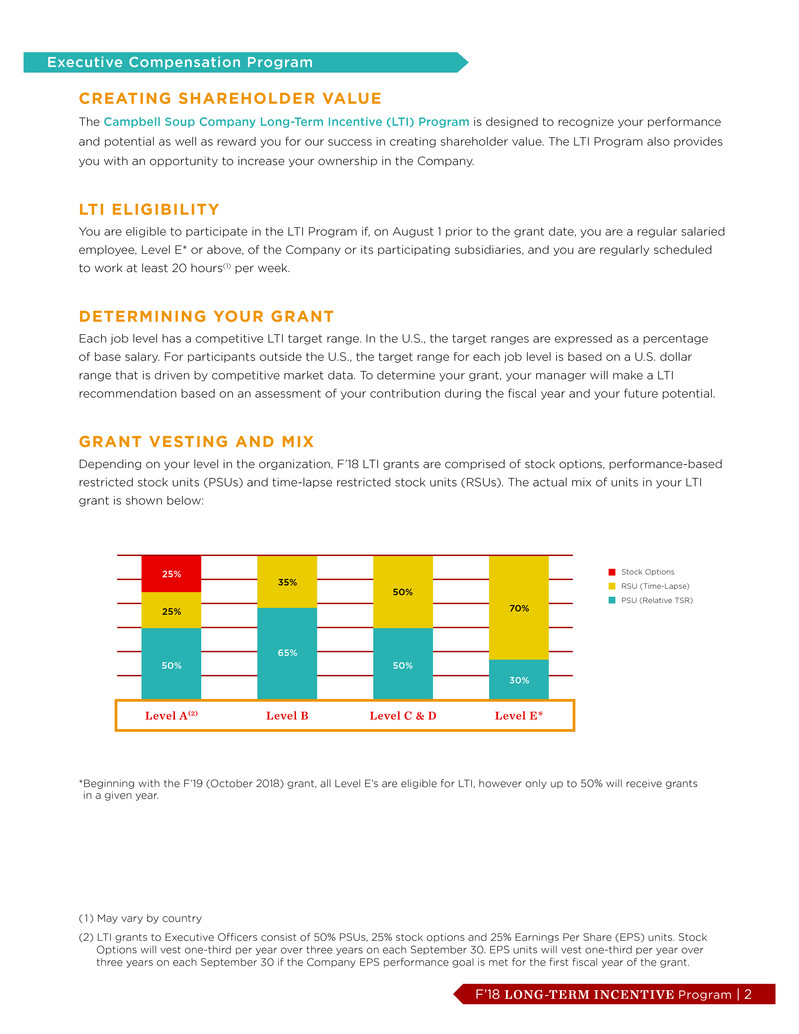
Executive Compensation Program
CreatIng sHareHoLder VaLUe
The Campbell Soup Company Long-Term Incentive (LTI) Program is designed to recognize your performance
and potential as well as reward you for our success in creating shareholder value. The LTI Program also provides
you with an opportunity to increase your ownership in the Company.
LtI eLIgIBILItY
You are eligible to participate in the LTI Program if, on August 1 prior to the grant date, you are a regular salaried
employee, Level E* or above, of the Company or its participating subsidiaries, and you are regularly scheduled
to work at least 20 hours(1) per week.
determInIng YoUr grant
Each job level has a competitive LTI target range. In the U.S., the target ranges are expressed as a percentage
of base salary. For participants outside the U.S., the target range for each job level is based on a U.S. dollar
range that is driven by competitive market data. To determine your grant, your manager will make a LTI
recommendation based on an assessment of your contribution during the fiscal year and your future potential.
grant VestIng and mIX
Depending on your level in the organization, F’18 LTI grants are comprised of stock options, performance-based
restricted stock units (PSUs) and time-lapse restricted stock units (RSUs). The actual mix of units in your LTI
grant is shown below:
F’18 LONG-TERM INCENTIVE Program | 2
Level A(2) Level B Level E*
50%
25%
25%
35%
65%
50%
50%
30%
70%
Stock Options
RSU (Time-Lapse)
PSU (Relative TSR)
( 1) May vary by country
(2) LTI grants to Executive Officers consist of 50% PSUs, 25% stock options and 25% Earnings Per Share (EPS) units. Stock
Options will vest one-third per year over three years on each September 30. EPS units will vest one-third per year over
three years on each September 30 if the Company EPS performance goal is met for the first fiscal year of the grant.
Level C & D
* Beginning with the F’19 (October 2018) grant, all Level E’s are eligible for LTI, however only up to 50% will receive grants
in a given year.
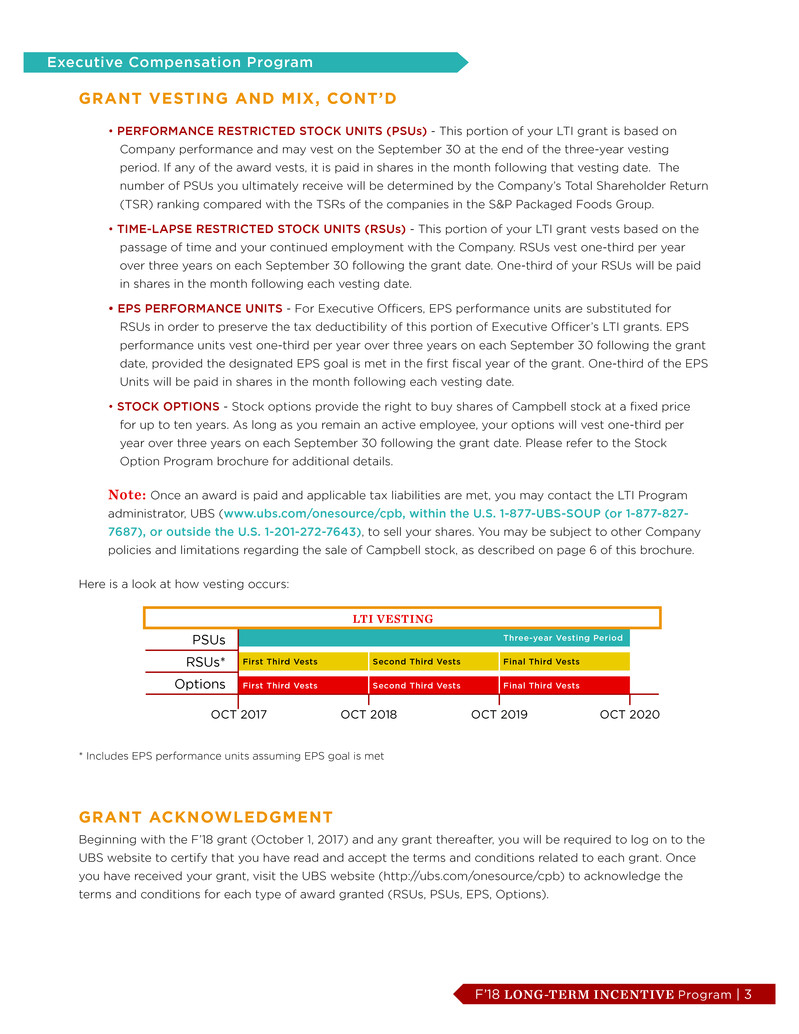
Executive Compensation Program
grant VestIng and mIX, Cont’d
• PERFORMANCE RESTRICTED STOCK UNITS (PSUs) - This portion of your LTI grant is based on
Company performance and may vest on the September 30 at the end of the three-year vesting
period. If any of the award vests, it is paid in shares in the month following that vesting date. The
number of PSUs you ultimately receive will be determined by the Company’s Total Shareholder Return
(TSR) ranking compared with the TSRs of the companies in the S&P Packaged Foods Group.
• TIME-LAPSE RESTRICTED STOCK UNITS (RSUs) - This portion of your LTI grant vests based on the
passage of time and your continued employment with the Company. RSUs vest one-third per year
over three years on each September 30 following the grant date. One-third of your RSUs will be paid
in shares in the month following each vesting date.
• EPS PErformancE UnitS - For Executive Officers, EPS performance units are substituted for
RSUs in order to preserve the tax deductibility of this portion of Executive Officer’s LTI grants. EPS
performance units vest one-third per year over three years on each September 30 following the grant
date, provided the designated EPS goal is met in the first fiscal year of the grant. One-third of the EPS
Units will be paid in shares in the month following each vesting date.
• STOCK OPTIONS - Stock options provide the right to buy shares of Campbell stock at a fixed price
for up to ten years. As long as you remain an active employee, your options will vest one-third per
year over three years on each September 30 following the grant date. Please refer to the Stock
Option Program brochure for additional details.
Note: Once an award is paid and applicable tax liabilities are met, you may contact the LTI Program
administrator, UBS (www.ubs.com/onesource/cpb, within the U.S. 1-877-UBS-SOUP (or 1-877-827-
7687), or outside the U.S. 1-201-272-7643), to sell your shares. You may be subject to other Company
policies and limitations regarding the sale of Campbell stock, as described on page 6 of this brochure.
Here is a look at how vesting occurs:
grant aCKnoWLedgment
Beginning with the F’18 grant (October 1, 2017) and any grant thereafter, you will be required to log on to the
UBS website to certify that you have read and accept the terms and conditions related to each grant. Once
you have received your grant, visit the UBS website (http://ubs.com/onesource/cpb) to acknowledge the
terms and conditions for each type of award granted (RSUs, PSUs, EPS, Options).
F’18 LONG-TERM INCENTIVE Program | 3
PSUs
RSUs*
Options
OCT 2017 OCT 2018 OCT 2019
LTI VESTING
OCT 2020
Three-year Vesting Period
Final Third Vests
Final Third Vests
Second Third Vests
Second Third Vests
First Third Vests
First Third Vests
* Includes EPS performance units assuming EPS goal is met
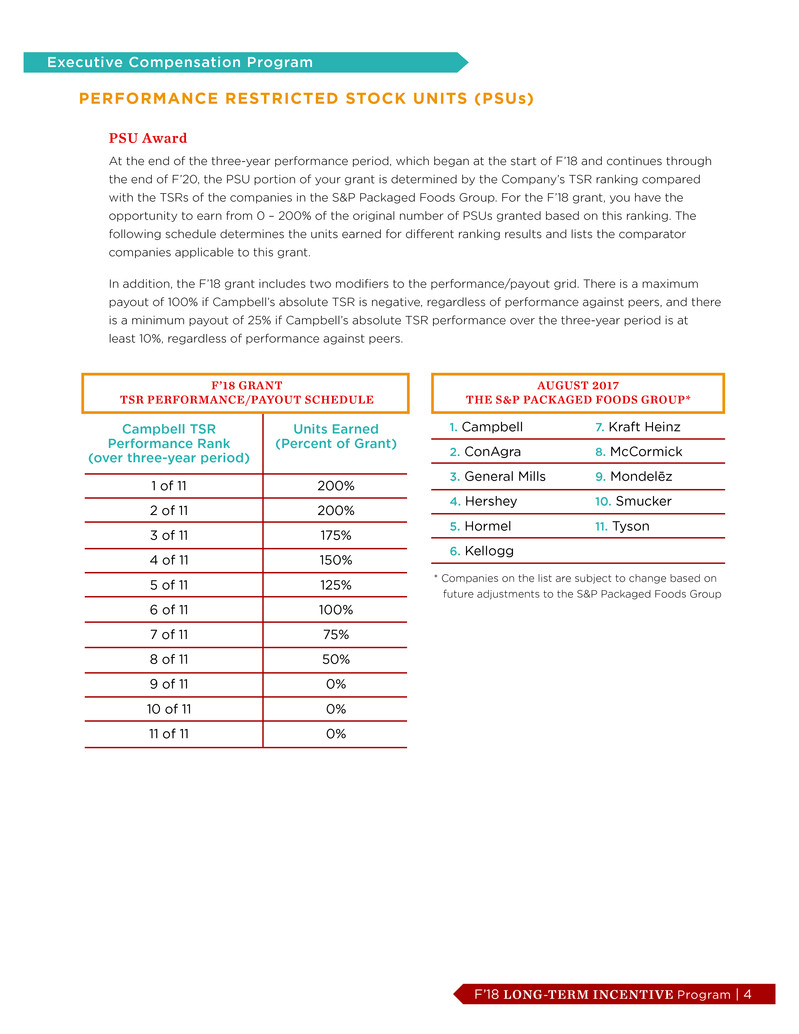
Executive Compensation Program
performanCe restrICted stoCK UnIts (psUs)
PSU Award
At the end of the three-year performance period, which began at the start of F’18 and continues through
the end of F’20, the PSU portion of your grant is determined by the Company’s TSR ranking compared
with the TSRs of the companies in the S&P Packaged Foods Group. For the F’18 grant, you have the
opportunity to earn from 0 – 200% of the original number of PSUs granted based on this ranking. The
following schedule determines the units earned for different ranking results and lists the comparator
companies applicable to this grant.
In addition, the F’18 grant includes two modifiers to the performance/payout grid. There is a maximum
payout of 100% if Campbell’s absolute TSR is negative, regardless of performance against peers, and there
is a minimum payout of 25% if Campbell’s absolute TSR performance over the three-year period is at
least 10%, regardless of performance against peers.
F’18 LONG-TERM INCENTIVE Program | 4
1 of 11
2 of 11
3 of 11
4 of 11
5 of 11
6 of 11
7 of 11
8 of 11
9 of 11
10 of 11
11 of 11
Campbell TSR
Performance Rank
(over three-year period)
200%
200%
175%
150%
125%
100%
75%
50%
0%
0%
0%
Units Earned
(Percent of Grant)
F’18 GRANT
TSR PERFORMANCE/PAYOUT SCHEDULE
1. Campbell
2. ConAgra
3. General Mills
4. Hershey
5. Hormel
6. Kellogg
7. Kraft Heinz
8. McCormick
9. Mondelēz
10. Smucker
11. Tyson
* Companies on the list are subject to change based on
future adjustments to the S&P Packaged Foods Group
AUGUST 2017
THE S&P PACKAGED FOODS GROUP*
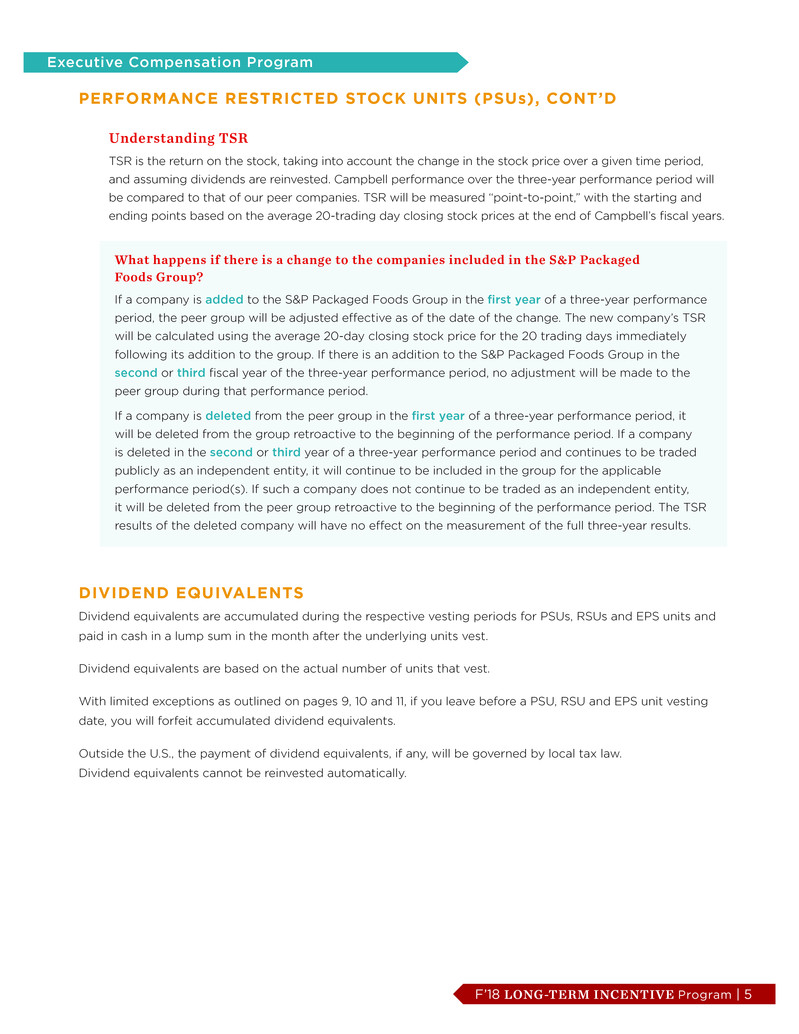
Executive Compensation Program
performanCe restrICted stoCK UnIts (psUs), Cont’d
Understanding TSR
TSR is the return on the stock, taking into account the change in the stock price over a given time period,
and assuming dividends are reinvested. Campbell performance over the three-year performance period will
be compared to that of our peer companies. TSR will be measured “point-to-point,” with the starting and
ending points based on the average 20-trading day closing stock prices at the end of Campbell’s fiscal years.
What happens if there is a change to the companies included in the S&P Packaged
Foods Group?
If a company is added to the S&P Packaged Foods Group in the first year of a three-year performance
period, the peer group will be adjusted effective as of the date of the change. The new company’s TSR
will be calculated using the average 20-day closing stock price for the 20 trading days immediately
following its addition to the group. If there is an addition to the S&P Packaged Foods Group in the
second or third fiscal year of the three-year performance period, no adjustment will be made to the
peer group during that performance period.
If a company is deleted from the peer group in the first year of a three-year performance period, it
will be deleted from the group retroactive to the beginning of the performance period. If a company
is deleted in the second or third year of a three-year performance period and continues to be traded
publicly as an independent entity, it will continue to be included in the group for the applicable
performance period(s). If such a company does not continue to be traded as an independent entity,
it will be deleted from the peer group retroactive to the beginning of the performance period. The TSR
results of the deleted company will have no effect on the measurement of the full three-year results.
F’18 LONG-TERM INCENTIVE Program | 5
dIVIdend eQUIVaLents
Dividend equivalents are accumulated during the respective vesting periods for PSUs, RSUs and EPS units and
paid in cash in a lump sum in the month after the underlying units vest.
Dividend equivalents are based on the actual number of units that vest.
With limited exceptions as outlined on pages 9, 10 and 11, if you leave before a PSU, RSU and EPS unit vesting
date, you will forfeit accumulated dividend equivalents.
Outside the U.S., the payment of dividend equivalents, if any, will be governed by local tax law.
Dividend equivalents cannot be reinvested automatically.
Executive Compensation Program
seLLIng YoUr stoCK - restrICtIons
Upon vesting, stock units are paid in shares. Once you own shares of Campbell stock, you may sell them like any
other shares you own. However, as an employee of the Company, you may be subject to special restrictions on
when you may sell your Campbell stock.
Specifically, if you have information that is considered “material” and has not yet been released to the public,
you may not buy or sell Campbell stock. Information is considered material if there is a likelihood that a
reasonable investor would consider that information important in deciding whether to buy, sell or hold Campbell
stock. Some examples of possible material information include any of the following unannounced to the public:
• Earning estimates
• Significant acquisitions or divestitures
• Significant new products
• Significant changes in operations
• Dividend increases or decreases
• Extraordinary management changes
If you buy or sell Campbell stock when you have this kind of information, you could be subject to civil and
criminal penalties under U.S. Federal securities laws.
In addition, certain employees who regularly receive confidential information about the Company can only buy
or sell Campbell stock during “trading windows.” The Legal Department notifies employees who are subject to
this limitation, and these employees must receive approval from the Legal Department in order to sell shares.
Also, you are subject to additional selling restrictions if you are covered by the Executive Stock Ownership
Program and have not yet met the ownership requirements. Please refer to the Executive Stock Ownership
Program brochure for more details.
Executive Officers may also be subject to restrictions under Securities and Exchange Commission Rule 144.
If you have any questions about the appropriateness of selling your Campbell stock, please consult the
Legal Department.
F’18 LONG-TERM INCENTIVE Program | 6
Executive Compensation Program
taXatIon
Based on current law, this section provides a general description of expected U.S. federal income tax effects on
PSUs, RSUs and EPS units. Please note that this section does not address Social Security, state, local and foreign
taxes, and any other tax consequences that could apply to you based on your circumstances. In addition, the
Company is not guaranteeing any particular tax results related to your award. The Company will withhold taxes
and report income amounts to the IRS and other taxing authorities as required by applicable law.
Due to the complexity of the tax rules applicable to these awards, please consult your personal tax advisor
before making any decisions about your awards.
Within the United States
For participants subject to United States taxation (U.S. citizens, including those on expatriate assignments
to other countries, “green card” holders, and any others treated as U.S. tax residents), current federal tax
law results in the following tax treatment:
• Units are not subject to income taxation at the time they are granted
• When grants are paid in shares, the fair market value of the shares is taxable as ordinary income
• Dividend equivalents on units are taxable as ordinary income when they are received
In order to meet any federal, state or local tax withholding obligations with respect to an award under the
LTI Program, you may elect to have the Company, subject to procedures established by the Company:
• Withhold all or a portion of an LTI award;
• Withhold from your paycheck; or
• You may write a personal check to cover the withholding
If you are or become eligible for retirement during the applicable vesting period, the Company may be
required to collect FICA taxes from you prior to vesting in the units or receipt of shares.
If a portion of your award is included in income under Internal Revenue Code section 409A, that portion
will be distributed to you immediately.
As required under applicable laws, the Company reports plan payments and other plan-related information
to the appropriate governmental agencies.
Outside the United States
To the extent the Company is required to withhold foreign taxes in connection with your PSU’s, RSU’s, EPS
units and stock options, the Company may require you to make arrangements as the Company deems
necessary for the payment of such taxes required to be withheld. You may contact your local tax or
financial advisor for information on the tax treatment of your award and dividend equivalent payments.
F’18 LONG-TERM INCENTIVE Program | 7
Executive Compensation Program
InCentIVe CompensatIon CLaWBaCK poLICY
In September 2017, the Board of Directors of the Company approved the Campbell Soup Company Incentive
Compensation Clawback Policy (the “Clawback Policy”) to better align our compensation practices with our
shareholders’ interests and ensure that incentive compensation is based upon accurate financial information.
The Clawback Policy allows for recovery of cash and equity incentive compensation of certain employees,(1)
which includes AIP awards and grants made under our LTI Program, in the event the Company is required to
prepare a material financial restatement due to fraud or intentional misconduct.
The Committee has sole discretion to determine whether and how to apply the Clawback Policy. In determining
whether to recover compensation, the Committee will consider whether the individual received incentive
compensation based on the original financial results that was in excess of the compensation that should have
been received based on the restated financial results. The Committee will also consider the accountability of the
individual for the restatement, including whether the individual engaged in the fraud or intentional misconduct.
A copy of the Clawback Policy can be found on the Winning With Integrity portal under Core Corporate Policies.
If you have any questions about the Clawback Policy, please contact the Legal Department.
F’18 LONG-TERM INCENTIVE Program | 8
( 1) The Clawback Policy covers Executive Officers, the Controller, and any current or former Company employee directly
or indirectly involved in the fraud or intentional misconduct.
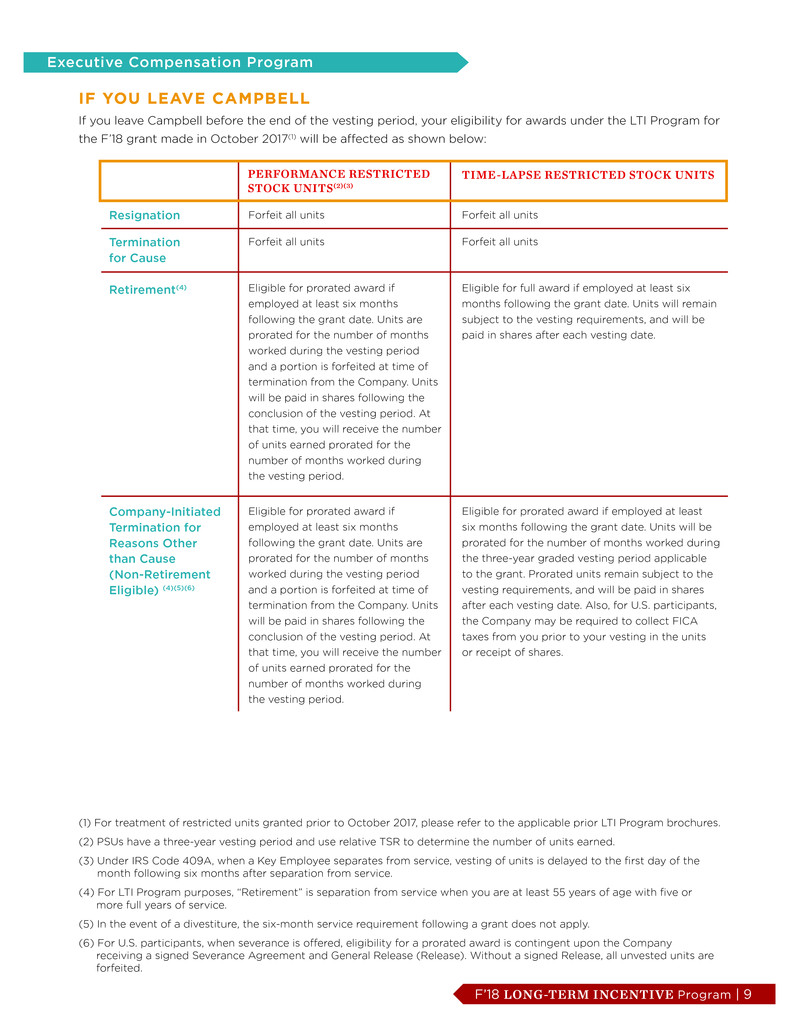
Executive Compensation Program
If YoU LeaVe CampBeLL
PERFORMANCE RESTRICTED
STOCK UNITS(2)(3)
TIME-LAPSE RESTRICTED STOCK UNITS
Resignation Forfeit all units
If you leave Campbell before the end of the vesting period, your eligibility for awards under the LTI Program for
the F’18 grant made in October 2017(1) will be affected as shown below:
Retirement(4)
Company-Initiated
Termination for
Reasons Other
than Cause
(Non-Retirement
Eligible) (4)(5)(6)
Termination
for Cause
F’18 LONG-TERM INCENTIVE Program | 9
Forfeit all units
Forfeit all units Forfeit all units
Eligible for prorated award if
employed at least six months
following the grant date. Units are
prorated for the number of months
worked during the vesting period
and a portion is forfeited at time of
termination from the Company. Units
will be paid in shares following the
conclusion of the vesting period. At
that time, you will receive the number
of units earned prorated for the
number of months worked during
the vesting period.
Eligible for full award if employed at least six
months following the grant date. Units will remain
subject to the vesting requirements, and will be
paid in shares after each vesting date.
Eligible for prorated award if
employed at least six months
following the grant date. Units are
prorated for the number of months
worked during the vesting period
and a portion is forfeited at time of
termination from the Company. Units
will be paid in shares following the
conclusion of the vesting period. At
that time, you will receive the number
of units earned prorated for the
number of months worked during
the vesting period.
Eligible for prorated award if employed at least
six months following the grant date. Units will be
prorated for the number of months worked during
the three-year graded vesting period applicable
to the grant. Prorated units remain subject to the
vesting requirements, and will be paid in shares
after each vesting date. Also, for U.S. participants,
the Company may be required to collect FICA
taxes from you prior to your vesting in the units
or receipt of shares.
(1) For treatment of restricted units granted prior to October 2017, please refer to the applicable prior LTI Program brochures.
(2) PSUs have a three-year vesting period and use relative TSR to determine the number of units earned.
(3) Under IRS Code 409A, when a Key Employee separates from service, vesting of units is delayed to the first day of the
month following six months after separation from service.
(4) For LTI Program purposes, “Retirement” is separation from service when you are at least 55 years of age with five or
more full years of service.
(5) In the event of a divestiture, the six-month service requirement following a grant does not apply.
(6) For U.S. participants, when severance is offered, eligibility for a prorated award is contingent upon the Company
receiving a signed Severance Agreement and General Release (Release). Without a signed Release, all unvested units are
forfeited.
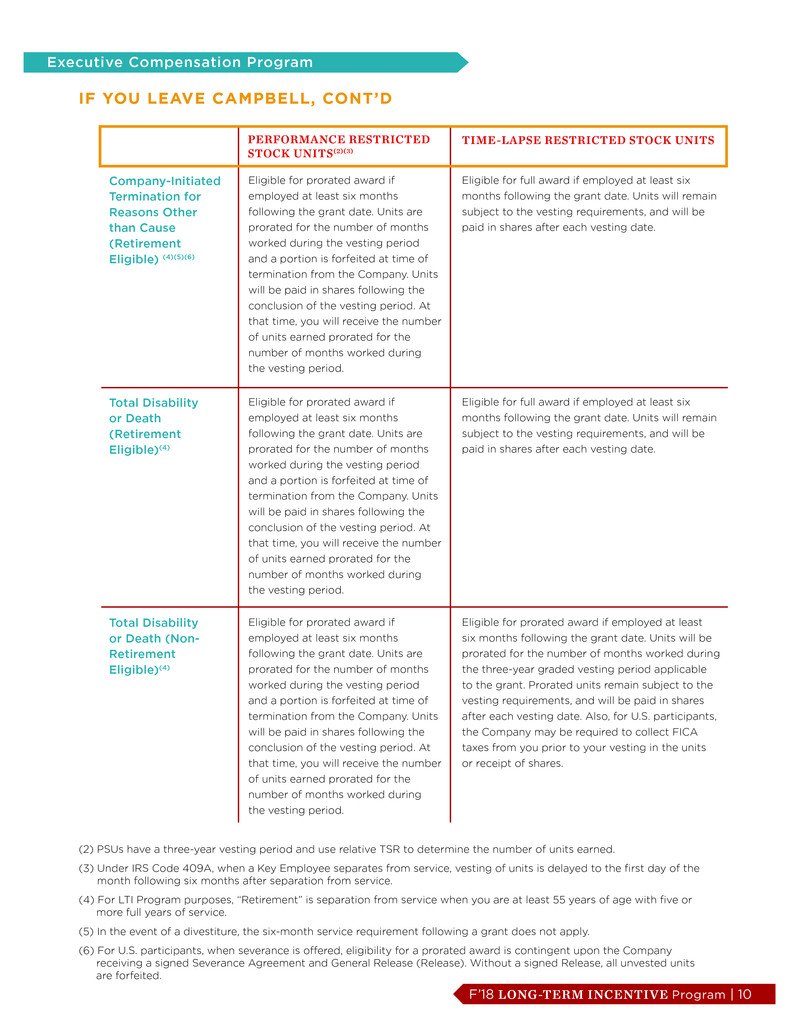
Executive Compensation Program
If YoU LeaVe CampBeLL
PERFORMANCE RESTRICTED
STOCK UNITS(2)(3)
TIME-LAPSE RESTRICTED STOCK UNITS
Eligible for prorated award if
employed at least six months
following the grant date. Units are
prorated for the number of months
worked during the vesting period
and a portion is forfeited at time of
termination from the Company. Units
will be paid in shares following the
conclusion of the vesting period. At
that time, you will receive the number
of units earned prorated for the
number of months worked during
the vesting period.
, Cont’d
Total Disability
or Death (Non-
Retirement
Eligible)(4)
Total Disability
or Death
(Retirement
Eligible)(4)
F’18 LONG-TERM INCENTIVE Program | 10
Eligible for full award if employed at least six
months following the grant date. Units will remain
subject to the vesting requirements, and will be
paid in shares after each vesting date.
(2) PSUs have a three-year vesting period and use relative TSR to determine the number of units earned.
(3) Under IRS Code 409A, when a Key Employee separates from service, vesting of units is delayed to the first day of the
month following six months after separation from service.
(4) For LTI Program purposes, “Retirement” is separation from service when you are at least 55 years of age with five or
more full years of service.
(5) In the event of a divestiture, the six-month service requirement following a grant does not apply.
(6) For U.S. participants, when severance is offered, eligibility for a prorated award is contingent upon the Company
receiving a signed Severance Agreement and General Release (Release). Without a signed Release, all unvested units
are forfeited.
Company-Initiated
Termination for
Reasons Other
than Cause
(Retirement
Eligible) (4)(5)(6)
Eligible for prorated award if
employed at least six months
following the grant date. Units are
prorated for the number of months
worked during the vesting period
and a portion is forfeited at time of
termination from the Company. Units
will be paid in shares following the
conclusion of the vesting period. At
that time, you will receive the number
of units earned prorated for the
number of months worked during
the vesting period.
Eligible for full award if employed at least six
months following the grant date. Units will remain
subject to the vesting requirements, and will be
paid in shares after each vesting date.
Eligible for prorated award if
employed at least six months
following the grant date. Units are
prorated for the number of months
worked during the vesting period
and a portion is forfeited at time of
termination from the Company. Units
will be paid in shares following the
conclusion of the vesting period. At
that time, you will receive the number
of units earned prorated for the
number of months worked during
the vesting period.
Eligible for prorated award if employed at least
six months following the grant date. Units will be
prorated for the number of months worked during
the three-year graded vesting period applicable
to the grant. Prorated units remain subject to the
vesting requirements, and will be paid in shares
after each vesting date. Also, for U.S. participants,
the Company may be required to collect FICA
taxes from you prior to your vesting in the units
or receipt of shares.
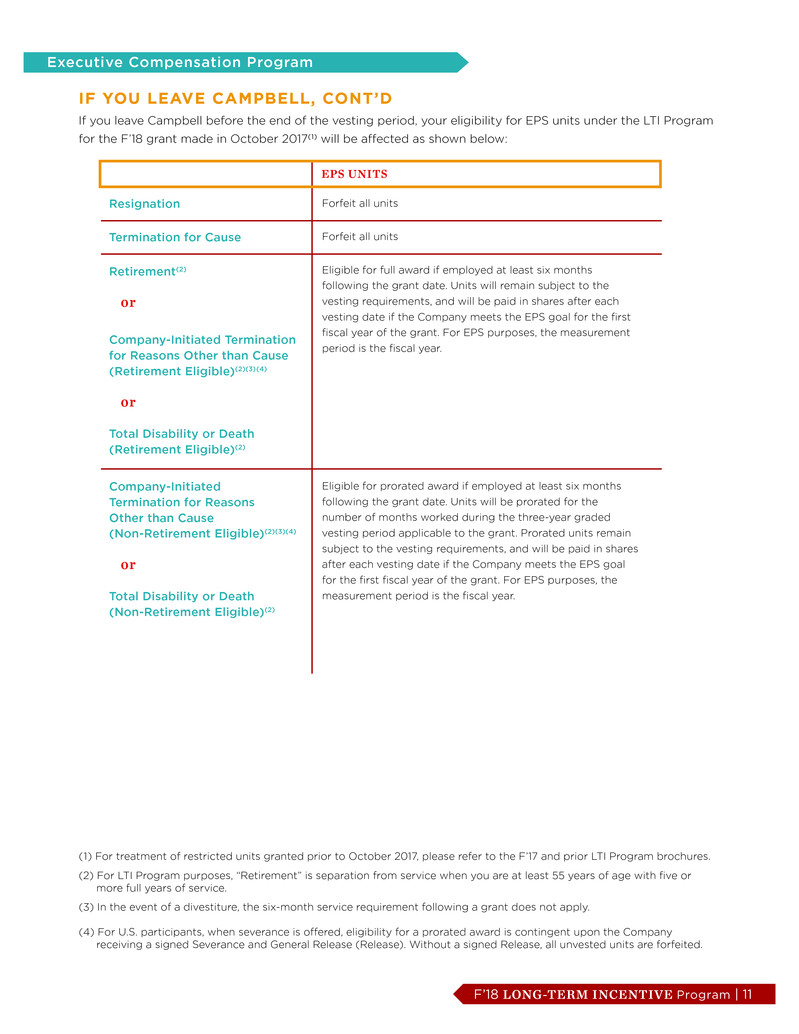
Executive Compensation Program
F’18 LONG-TERM INCENTIVE Program | 11
(1) For treatment of restricted units granted prior to October 2017, please refer to the F’17 and prior LTI Program brochures.
(2) For LTI Program purposes, “Retirement” is separation from service when you are at least 55 years of age with five or
more full years of service.
(3) In the event of a divestiture, the six-month service requirement following a grant does not apply.
(4) For U.S. participants, when severance is offered, eligibility for a prorated award is contingent upon the Company
receiving a signed Severance and General Release (Release). Without a signed Release, all unvested units are forfeited.
If YoU LeaVe CampBeLL, Cont’d
If you leave Campbell before the end of the vesting period, your eligibility for EPS units under the LTI Program
for the F’18 grant made in October 2017(1) will be affected as shown below:
EPS UNITS
Resignation Forfeit all units
Retirement(2)
or
Company-Initiated
Termination for Reasons
Other than Cause
(Non-Retirement Eligible)(2)(3)(4)
or
Total Disability or Death
(Non-Retirement Eligible)(2)
Termination for Cause Forfeit all units
Eligible for full award if employed at least six months
following the grant date. Units will remain subject to the
vesting requirements, and will be paid in shares after each
vesting date if the Company meets the EPS goal for the first
fiscal year of the grant. For EPS purposes, the measurement
period is the fiscal year.
Eligible for prorated award if employed at least six months
following the grant date. Units will be prorated for the
number of months worked during the three-year graded
vesting period applicable to the grant. Prorated units remain
subject to the vesting requirements, and will be paid in shares
after each vesting date if the Company meets the EPS goal
for the first fiscal year of the grant. For EPS purposes, the
measurement period is the fiscal year.
Company-Initiated Termination
for Reasons Other than Cause
(Retirement Eligible)(2)(3)(4)
or
Total Disability or Death
(Retirement Eligible)(2)
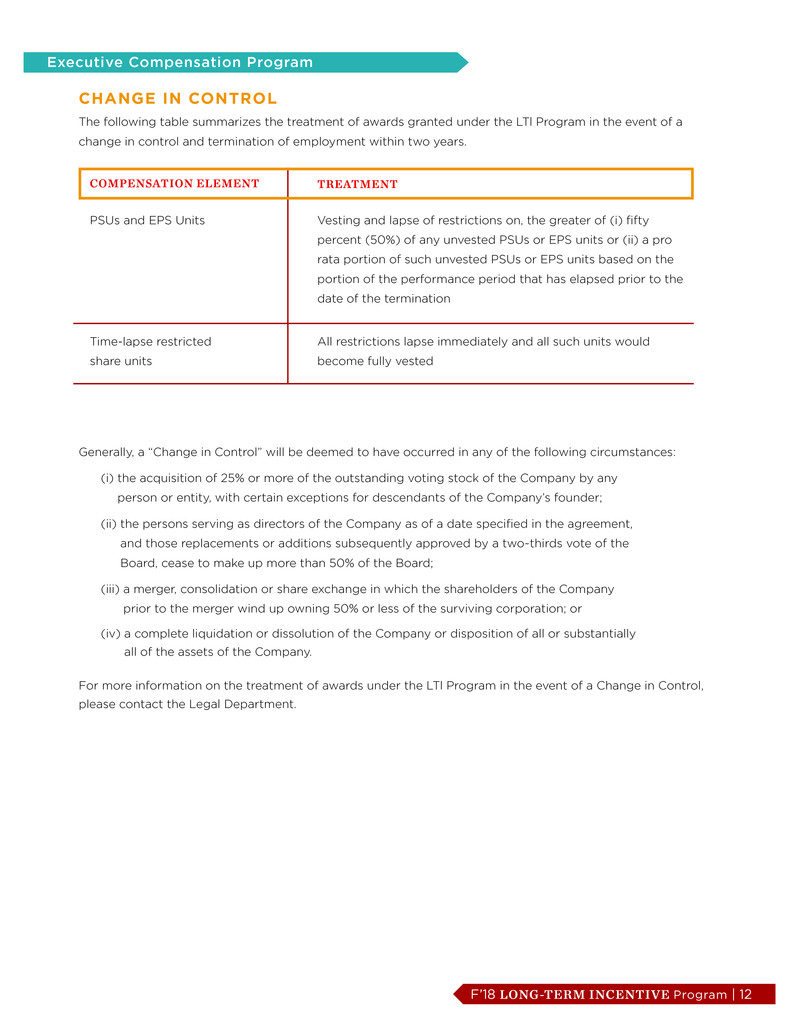
Executive Compensation Program
F’18 LONG-TERM INCENTIVE Program | 12
CHange In ControL
The following table summarizes the treatment of awards granted under the LTl Program in the event of a
change in control and termination of employment within two years.
Generally, a “Change in Control” will be deemed to have occurred in any of the following circumstances:
(i) the acquisition of 25% or more of the outstanding voting stock of the Company by any
person or entity, with certain exceptions for descendants of the Company’s founder;
(ii) the persons serving as directors of the Company as of a date specified in the agreement,
and those replacements or additions subsequently approved by a two~thirds vote of the
Board, cease to make up more than 50% of the Board;
(iii) a merger, consolidation or share exchange in which the shareholders of the Company
prior to the merger wind up owning 50% or less of the surviving corporation; or
(iv) a complete liquidation or dissolution of the Company or disposition of all or substantially
all of the assets of the Company.
For more information on the treatment of awards under the LTl Program in the event of a Change in Control,
please contact the Legal Department.
All restrictions lapse immediately and all such units would
become fully vested
Vesting and lapse of restrictions on, the greater of (i) fifty
percent (50%) of any unvested PSUs or EPS units or (ii) a pro
rata portion of such unvested PSUs or EPS units based on the
portion of the performance period that has elapsed prior to the
date of the termination
PSUs and EPS Units
Time-lapse restricted
share units
COMPENSATION ELEMENT TREATMENT
Executive Compensation Program
F’18 LONG-TERM INCENTIVE Program | 13
KeY terms
Committee – The Compensation and Organization Committee of the Campbell Soup Company Board
of Directors.
Company – Campbell Soup Company and its participating subsidiaries.
Dividend equivalents – The amount paid on a unit which is equal in value to the dividend paid on a share
of Campbell stock.
Key Employee – A U.S.-based executive in level A or B, who is subject to a six-month hold on any unvested
grant following termination.
Internal Revenue Code section 409A – Section 409A of the U.S. Internal Revenue Code of 1986, as
amended from time to time. This provision of the U.S. Federal tax rules applies to units which, for tax purposes,
are a form of nonqualified deferred compensation.
LTI award – An award issued under the Plan.
LTI grant – The number of units issued to an executive who participates in the LTI Program.
S&P Packaged Foods Group – The peer group used to measure our TSR ranking. As of August 2017, the
group included the following companies: Campbell, ConAgra, General Mills, Hershey, Hormel, Kellogg, Kraft
Heinz, McCormick, Mondelēz International, Smucker and Tyson.
Securities and Exchange Commission Rule 144 – Rule 144 under the Securities Act of 1933, as amended
(“Securities Act”), is a safe-harbor for affiliates (generally, executive officers and directors) to sell shares of
Campbell stock under the Securities Act. For additional information on Rule 144 and its requirements, please
contact the Company’s Legal Department.
Termination for cause – The termination of a participant’s employment by reason of his or her (1) engaging
in gross misconduct that is injurious to the Company, monetarily or otherwise, (2) misappropriation of funds, (3)
willful misrepresentation to the directors or officers of the Company, (4) gross negligence in the performance
of the participant’s duties having an adverse effect on the business, operations, assets, properties or financial
condition of the Company, (5) conviction of a crime involving moral turpitude, or (6) entering into competition
with the Company. The determination of whether a participant’s employment was terminated for cause shall be
made by the Company in its sole discretion.
Vesting – The point at which your right to receive shares is no longer subject to forfeiture.
Executive Compensation Program
F’18 LONG-TERM INCENTIVE Program | 14
addItIonaL LegaL terms
Entire Agreement – The terms of the LTI Award, the Plan and this Brochure when accepted by you will
constitute the entire agreement (the “Agreement”) with respect to the subject matter hereof and supersedes
any prior agreements, representations or promises of the parties relating to the subject matter hereof.
Limits on Transferability – LTI Awards and any interest therein may not be sold, pledged, assigned,
hypothecated, transferred, or disposed of in any manner, other than by will or by the laws of descent or
distribution. LTI Awards shall not be subject to execution, attachment or other process.
Severability – If one or more of the provisions of the Agreement shall be held invalid, illegal or unenforceable in
any respect, the validity, legality and enforceability of the remaining provisions shall not in any way be affected
or impaired thereby and the invalid, illegal or unenforceable provisions shall be deemed null and void.
Compliance with Securities Laws – Company stock shall not be issued with respect to this award unless
the issuance and delivery of such stock shall comply with all relevant provisions of state and federal laws, rules
and regulations, and, in the discretion of the Company, shall be further subject to the approval of counsel for the
Company with respect to that compliance.
No Employment or Voting Rights – The Agreement shall not give you the right to be retained in the
employment of the Company or its subsidiaries or affect the right of any such employer to terminate you. You
shall have no voting rights with respect to the Company’s stock units.
Successors – This terms and conditions of the Agreement shall be binding upon and inure to the benefit of any
successor or successors of the Company and any person or persons who shall acquire any rights hereunder.
Internal Revenue Code Section 409A – The terms of the Agreement and the Plan shall be interpreted,
operated, and administered in a manner so as not to subject any participant to the assessment of additional
taxes or interest under Code section 409A to the extent any such participant or any payment under the
Agreement is subject to U.S. tax laws, and the terms of the Agreement shall be amended as the Company, in its
sole discretion, determines is necessary and appropriate to avoid the application of any such taxes or interest.
Governing Law; Jurisdiction – This Agreement shall be construed in accordance with, and its interpretation
shall otherwise be governed by, New Jersey law. Each party irrevocably agrees that any legal proceeding arising
out of, or relating to the subject matter of, this Agreement shall be brought in the Superior Court of New Jersey
in Camden County or the United States District Court for the District of New Jersey located in Camden, New
Jersey. Each party irrevocably consents to such jurisdiction and venue.
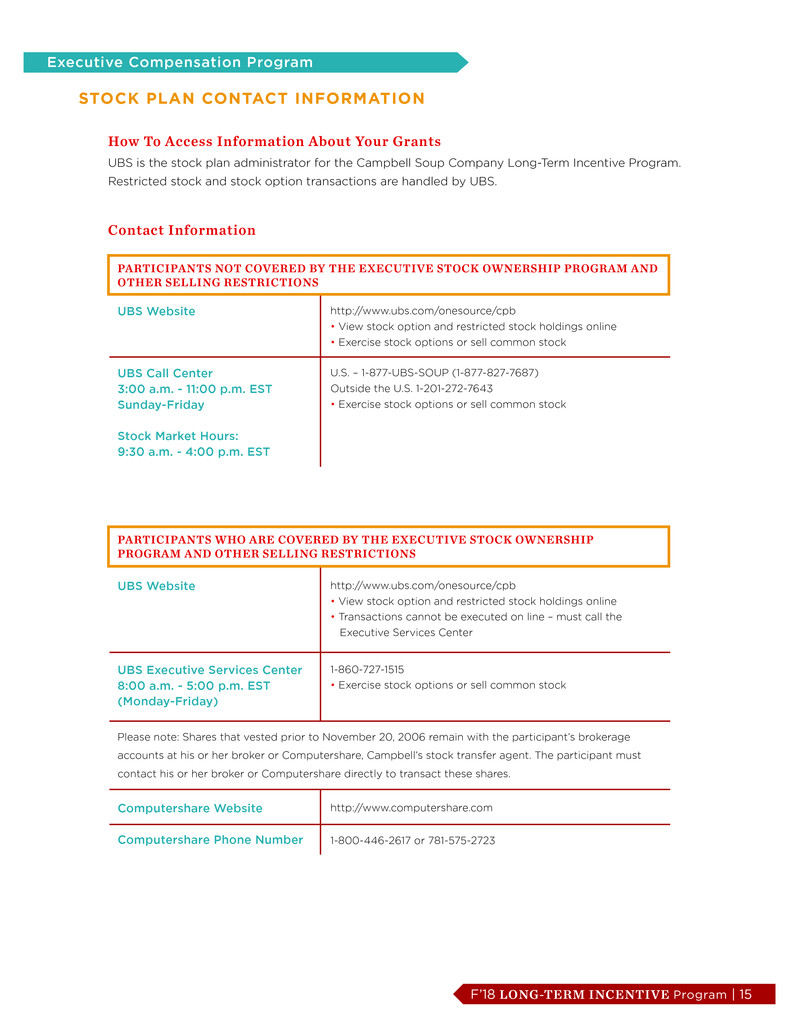
Executive Compensation Program
F’18 LONG-TERM INCENTIVE Program | 15
stoCK pLan ContaCt InformatIon
How To Access Information About Your Grants
UBS is the stock plan administrator for the Campbell Soup Company Long-Term Incentive Program.
Restricted stock and stock option transactions are handled by UBS.
Contact Information
PARTICIPANTS NOT COVERED BY THE EXECUTIVE STOCK OWNERSHIP PROGRAM AND
OTHER SELLING RESTRICTIONS
UBS Website http://www.ubs.com/onesource/cpb
• View stock option and restricted stock holdings online
• Exercise stock options or sell common stock
UBS Call Center
3:00 a.m. - 11:00 p.m. EST
Sunday-Friday
Stock Market Hours:
9:30 a.m. - 4:00 p.m. EST
U.S. – 1-877-UBS-SOUP (1-877-827-7687)
Outside the U.S. 1-201-272-7643
• Exercise stock options or sell common stock
UBS Executive Services Center
8:00 a.m. - 5:00 p.m. EST
(Monday-Friday)
Computershare Website
Computershare Phone Number
http://www.ubs.com/onesource/cpb
• View stock option and restricted stock holdings online
• Transactions cannot be executed on line – must call the
Executive Services Center
1-860-727-1515
• Exercise stock options or sell common stock
http://www.computershare.com
1-800-446-2617 or 781-575-2723
UBS Website
PARTICIPANTS WHO ARE COVERED BY THE EXECUTIVE STOCK OWNERSHIP
PROGRAM AND OTHER SELLING RESTRICTIONS
Please note: Shares that vested prior to November 20, 2006 remain with the participant’s brokerage
accounts at his or her broker or Computershare, Campbell’s stock transfer agent. The participant must
contact his or her broker or Computershare directly to transact these shares.
EXHIBIT 10(b)
CAMPBELL SOUP COMPANY
Non-Employee Director Compensation for Calendar 2018
Board and Committee Retainer for Calendar 2018
$119,000 shall be paid in cash
$129,000 shall be paid in shares of Campbell stock
Additional Retainers for Chairman of the Board, Committee Chairs and Audit Committee Members
In addition to the above Board and Committee retainer, the following amounts shall be paid 50% in cash and 50% in shares of Campbell stock:
$350,000 | Chairman of the Board |
$25,000 | Audit Committee chair |
$20,000 | Compensation and Organization Committee chair |
$15,000 | Finance Committee chair |
$15,000 | Governance Committee chairs |
$7,500 | Audit Committee members (excluding the Audit Committee chair) |
Prior to the beginning of a calendar year, a non-employee director may elect to (i) receive shares of Campbell stock in lieu of the cash portion of any retainer (such election to be made in 10% increments) and/or (ii) defer all or a portion of any cash or stock retainer in accordance with the terms and conditions of the Campbell Soup Company Supplemental Retirement Plan.
EXHIBIT 31(a)
CERTIFICATION PURSUANT
TO RULE 13a-14(a)
I, Denise M. Morrison, certify that:
1. I have reviewed this Quarterly Report on Form 10-Q of Campbell Soup Company;
2. Based on my knowledge, this report does not contain any untrue statement of a material fact or omit to state a material fact necessary to make the statements made, in light of the circumstances under which such statements were made, not misleading with respect to the period covered by this report;
3. Based on my knowledge, the financial statements, and other financial information included in this report, fairly present in all material respects the financial condition, results of operations and cash flows of the registrant as of, and for, the periods presented in this report;
4. The registrant’s other certifying officer(s) and I are responsible for establishing and maintaining disclosure controls and procedures (as defined in Exchange Act Rules 13a-15(e) and 15d-15(e)) and internal control over financial reporting (as defined in Exchange Act Rules 13a-15(f) and 15d-15(f)) for the registrant and have:
a) designed such disclosure controls and procedures, or caused such disclosure controls and procedures to be designed under our supervision, to ensure that material information relating to the registrant, including its consolidated subsidiaries, is made known to us by others within those entities, particularly during the period in which this report is being prepared;
b) designed such internal control over financial reporting, or caused such internal control over financial reporting to be designed under our supervision, to provide reasonable assurance regarding the reliability of financial reporting and the preparation of financial statements for external purposes in accordance with generally accepted accounting principles;
c) evaluated the effectiveness of the registrant’s disclosure controls and procedures and presented in this report our conclusions about the effectiveness of the disclosure controls and procedures, as of the end of the period covered by this report based on such evaluation; and
d) disclosed in this report any change in the registrant’s internal control over financial reporting that occurred during the registrant’s most recent fiscal quarter (the registrant’s fourth fiscal quarter in the case of an annual report) that has materially affected, or is reasonably likely to materially affect, the registrant’s internal control over financial reporting; and
5. The registrant’s other certifying officer(s) and I have disclosed, based on our most recent evaluation of internal control over financial reporting, to the registrant’s auditors and the audit committee of the registrant’s board of directors (or persons performing the equivalent functions):
a) all significant deficiencies and material weaknesses in the design or operation of internal control over financial reporting which are reasonably likely to adversely affect the registrant’s ability to record, process, summarize and report financial information; and
b) any fraud, whether or not material, that involves management or other employees who have a significant role in the registrant’s internal control over financial reporting.
Date: December 8, 2017
By: | /s/ Denise M. Morrison | ||||
Name: | Denise M. Morrison | ||||
Title: | President and Chief Executive Officer | ||||
EXHIBIT 31(b)
CERTIFICATION PURSUANT
TO RULE 13a-14(a)
I, Anthony P. DiSilvestro, certify that:
1. I have reviewed this Quarterly Report on Form 10-Q of Campbell Soup Company;
2. Based on my knowledge, this report does not contain any untrue statement of a material fact or omit to state a material fact necessary to make the statements made, in light of the circumstances under which such statements were made, not misleading with respect to the period covered by this report;
3. Based on my knowledge, the financial statements, and other financial information included in this report, fairly present in all material respects the financial condition, results of operations and cash flows of the registrant as of, and for, the periods presented in this report;
4. The registrant’s other certifying officer(s) and I are responsible for establishing and maintaining disclosure controls and procedures (as defined in Exchange Act Rules 13a-15(e) and 15d-15(e)) and internal control over financial reporting (as defined in Exchange Act Rules 13a-15(f) and 15d-15(f)) for the registrant and have:
a) designed such disclosure controls and procedures, or caused such disclosure controls and procedures to be designed under our supervision, to ensure that material information relating to the registrant, including its consolidated subsidiaries, is made known to us by others within those entities, particularly during the period in which this report is being prepared;
b) designed such internal control over financial reporting, or caused such internal control over financial reporting to be designed under our supervision, to provide reasonable assurance regarding the reliability of financial reporting and the preparation of financial statements for external purposes in accordance with generally accepted accounting principles;
c) evaluated the effectiveness of the registrant’s disclosure controls and procedures and presented in this report our conclusions about the effectiveness of the disclosure controls and procedures, as of the end of the period covered by this report based on such evaluation; and
d) disclosed in this report any change in the registrant’s internal control over financial reporting that occurred during the registrant’s most recent fiscal quarter (the registrant’s fourth fiscal quarter in the case of an annual report) that has materially affected, or is reasonably likely to materially affect, the registrant’s internal control over financial reporting; and
5. The registrant’s other certifying officer(s) and I have disclosed, based on our most recent evaluation of internal control over financial reporting, to the registrant’s auditors and the audit committee of the registrant’s board of directors (or persons performing the equivalent functions):
a) all significant deficiencies and material weaknesses in the design or operation of internal control over financial reporting which are reasonably likely to adversely affect the registrant’s ability to record, process, summarize and report financial information; and
b) any fraud, whether or not material, that involves management or other employees who have a significant role in the registrant’s internal control over financial reporting.
Date: December 8, 2017
By: | /s/ Anthony P. DiSilvestro | ||||
Name: | Anthony P. DiSilvestro | ||||
Title: | Senior Vice President and Chief Financial | ||||
Officer | |||||
EXHIBIT 32(a)
CERTIFICATION PURSUANT TO
18 U.S.C. SECTION 1350
In connection with the Quarterly Report of Campbell Soup Company (the “Company”) on Form 10-Q for the fiscal quarter ended October 29, 2017 (the “Report”), I, Denise M. Morrison, President and Chief Executive Officer of the Company, hereby certify, pursuant to 18 U.S.C. Section 1350, as adopted pursuant to Section 906 of the Sarbanes-Oxley Act of 2002, that, to my knowledge:
(1) The Report fully complies with the requirements of Section 13(a) or 15(d) of the Securities Exchange Act of 1934; and
(2) The information contained in the Report fairly presents, in all material respects, the financial condition and results of operations of the Company.
Date: December 8, 2017
By: | /s/ Denise M. Morrison | ||||
Name: | Denise M. Morrison | ||||
Title: | President and Chief Executive Officer | ||||
The foregoing certification is being furnished solely pursuant to 18 U.S.C. Section 1350 and is not being filed as part of the Report or as a separate disclosure document.
A signed original of this written statement required under Section 906 has been provided to the Company and will be retained by the Company and furnished to the Securities and Exchange Commission or its staff upon request.
EXHIBIT 32(b)
CERTIFICATION PURSUANT TO
18 U.S.C. SECTION 1350
In connection with the Quarterly Report of Campbell Soup Company (the “Company”) on Form 10-Q for the fiscal quarter ended October 29, 2017 (the “Report”), I, Anthony P. DiSilvestro, Senior Vice President and Chief Financial Officer of the Company, hereby certify, pursuant to 18 U.S.C. Section 1350, as adopted pursuant to Section 906 of the Sarbanes-Oxley Act of 2002, that, to my knowledge:
(1) The Report fully complies with the requirements of Section 13(a) or 15(d) of the Securities Exchange Act of 1934; and
(2) The information contained in the Report fairly presents, in all material respects, the financial condition and results of operations of the Company.
Date: December 8, 2017
By: | /s/ Anthony P. DiSilvestro | ||||
Name: | Anthony P. DiSilvestro | ||||
Title: | Senior Vice President and Chief Financial | ||||
Officer | |||||
The foregoing certification is being furnished solely pursuant to 18 U.S.C. Section 1350 and is not being filed as part of the Report or as a separate disclosure document.
A signed original of this written statement required under Section 906 has been provided to the Company and will be retained by the Company and furnished to the Securities and Exchange Commission or its staff upon request.